



How the Women in Vinyl Scholarship Winner Is Redefining Music Instruction and Electronic Performance
Technology might serve as the new educational foundation for the modern musician, but vinyls still remain a tool for creativity. Luana Bittencourt combines both, which is part of the reason that she was awarded the Berklee Online Women in Vinyl Scholarship, empowering women in the industry and keeping the physical media alive.
Bittencourt is the founder of the Music Room Academy, a music school where she teaches children of all ages about music theory and technology, fostering innovation while preserving the traditional foundations of music. Apart from her work as an educator, she also releases music as an artist, where she has explored different sounds within the field of electronic music.
She says her passion for music began during her childhood years when she would immerse herself in her parents’ vinyl collection. Growing up in Brazil, she remembers listening to bossa nova and classic rock artists, including Led Zeppelin, Janis Joplin, and Pink Floyd.
“Those albums sparked my curiosity long before I understood anything about recording, production, or the people behind the music,” she says. “They taught me that music has the power to tell stories, connect generations, and inspire creativity.”
Women in Vinyl Scholarship
The Women in Vinyl Scholarship is offered by Berklee Online in partnership with Women in Vinyl and Marshall. For Bittencourt, this scholarship aligned with her goals of using vinyl records as a teaching method to spark creativity in her students. Bittencourt also encourages girls and young women to learn music through technology and build their career from the ground up.
“In my classroom I have this space where we have a record player and a collection of vinyls. All my students have time during the class to go choose one,” says Bittencourt. “There are days that I just go, listen to a track, get inspired, and meet some artists I didn’t know. Sometimes we do some sampling with some parts of the vinyl.”
Bittencourt is a classically trained musician, and says she learned music through more traditional ways of instruction than the way she teaches. After moving to the United States in hopes to expand her career in music education, she uncovered a passion for music technology and modern production, which demanded new methods.
“I realized that many young people connect with music through beat-making, electronic production, and digital creativity, yet these areas are often missing from traditional music education,” says Bittencourt.
With her Women in Vinyl scholarship, Bittencourt completed the Ableton Live certificate with Berklee Online, and she says she wants to use what she learned to serve the community around her by creating new curricula for her students, introducing new technology into classrooms, and opening doors for several forms of self-expression. She says this is part of the reason why she began to explore innovative pathways in music education, teaching her students how to sample and DJ with vinyl records.
“Receiving the Women in Vinyl scholarship to study at Berklee Online became a turning point in my career,” says Bittencourt. “I began to see technology not as a replacement for musicianship, but as a powerful bridge that helps students understand rhythm, harmony, composition, and creativity in an engaging and accessible way.”
As an educator, Bittencourt says she began to notice the underrepresentation of women in the fields of technology, electronic music, and audio production, which encouraged her to challenge the traditional path that women are used to following in the industry.
Music Room Academy
Bittencourt’s Berklee Online experience wasn’t her first with the college. She had previously attended the Aspire: Five-Week Music Performance Intensive, a part of Berklee Summer Programs, specializing in Electronic Music Performance. Though the program is traditionally made up of younger learners, Bittencourt says her experience at Five-Week in her late 30s helped her further understand the needs of the future generation of musicians. Despite being one of the oldest students, she says she enjoys learning with children and teenagers, which explains her love for teaching.
During this program, she began to realize that many of her classmates knew a lot about digital audio workstations, but not as much about things like reading music. In hopes of filling that gap, Bittencourt started the Music Room Academy, focusing on teaching the foundations of music through technology.
“I always love the technology part because I play keyboard, so I need to do a little bit of sound design and produce some tracks,” says Bittencourt. “I felt like the mission was to bring this to the classroom.”
Through a carefully crafted curriculum, the Music Room Academy offers what Bittencourt calls a “creative educational ecosystem” that provides hands-on music experiences, studio lab classes, performance opportunities, and electronic music exploration, all of which differ from a conventional music school.
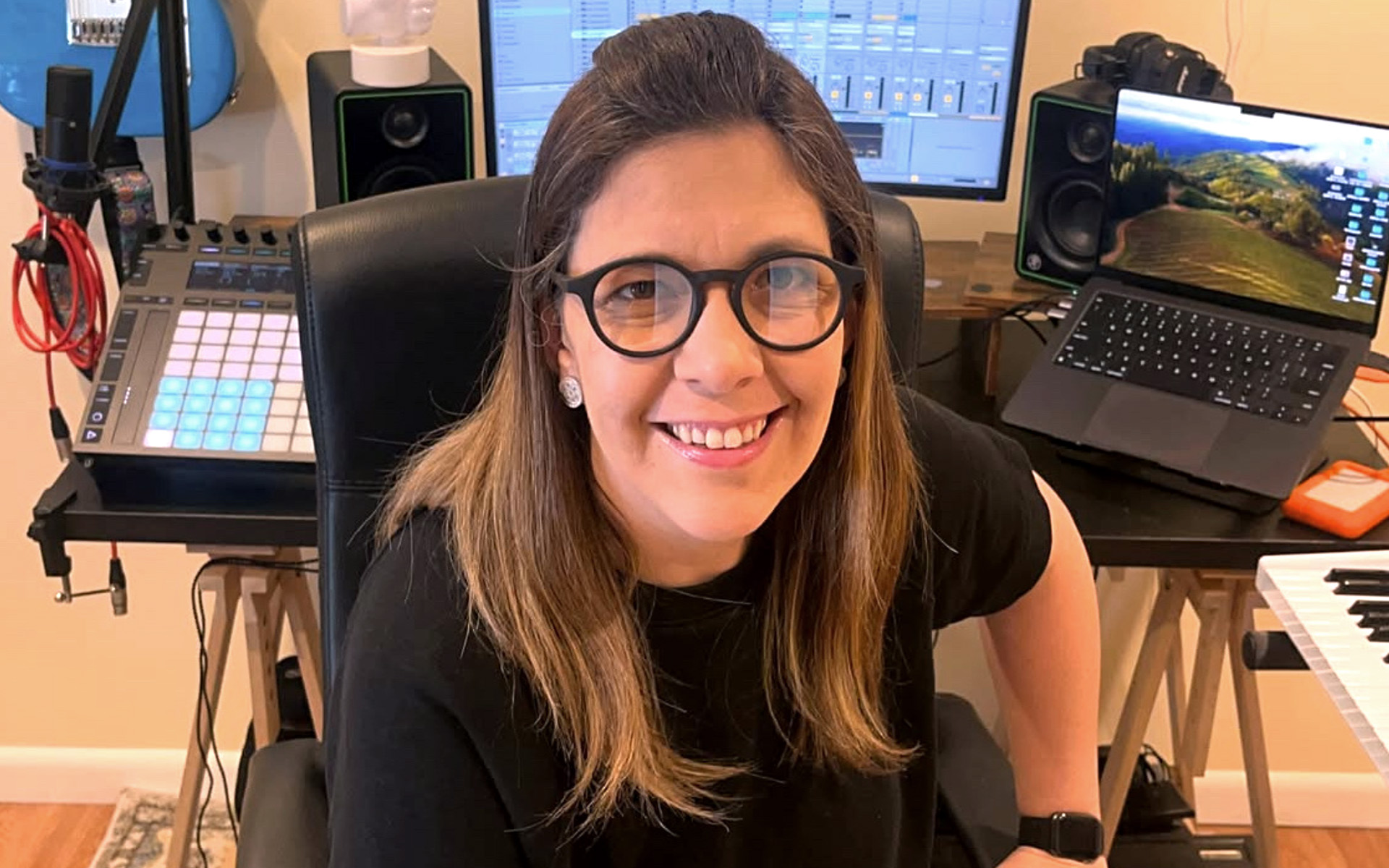
“We are a community project, so we have this studio lab with computer stations, MIDI controllers, guitars, pianos, drums… We have group classes where each one has their own station and has a couple of programs running,” says Bittencourt. “Seeing a student write their first original piece or proudly share something they created from scratch reminds me why this work matters so much.”
Creating Music
Bittencourt says her own music benefitted from her certificate, especially after taking the Performing with Ableton Live course. Producing music that’s a mix of electronic and ambient house, she combines live instruments with electronic sounds to reach a balance between computer-generated effects and the organic sound of the piano.
“That class was where I woke up for some things like DJing or even performing with live electronic instruments,” she says. “Because of that class, I started building my sets. Today I have a partnership with Ableton on my projects, so it’s pretty cool.”
Bittencourt talks about her album The Moments Between, which she produced and released last year.
“They’re songs to meditate to, to relax: A stop between your rushed time,” she says. “The titles of the songs are about that moment when nothing happens. That moment is important.”
Her knowledge of electronic music has led her to collaborate with other artists and musicians who are more drawn to playing an instrument or singing. Bittencourt can bring to life some electronic sounds into her live performances, presenting the audience with another version of a song.
“On my next set, I’m playing these songs and I’m joining another artist. She’s a singer and she wants to bring electronic elements to her set, so we connect through that. I’m going to bring the electronic elements: the synthesizer, drum machines, and all that,” she says.
Bittencourt’s plans for her future career include continuing to learn about the technical aspects of electronic music production, and updating her educational approaches with new technology.
“This opportunity would multiply that impact, reaching not only me, but every student who walks into my classroom,” mentions Bittencourt. “I am deeply grateful for Women in Vinyl’s commitment to supporting women in music, and I hope to continue carrying that mission forward by inspiring the next generation of creators.”