

From Teenage Metalhead to Berklee Instructor, the Guitarist Shares Stories of Unforgettable Gigs, Unlikely Encounters, and Finding Her Musical Voice
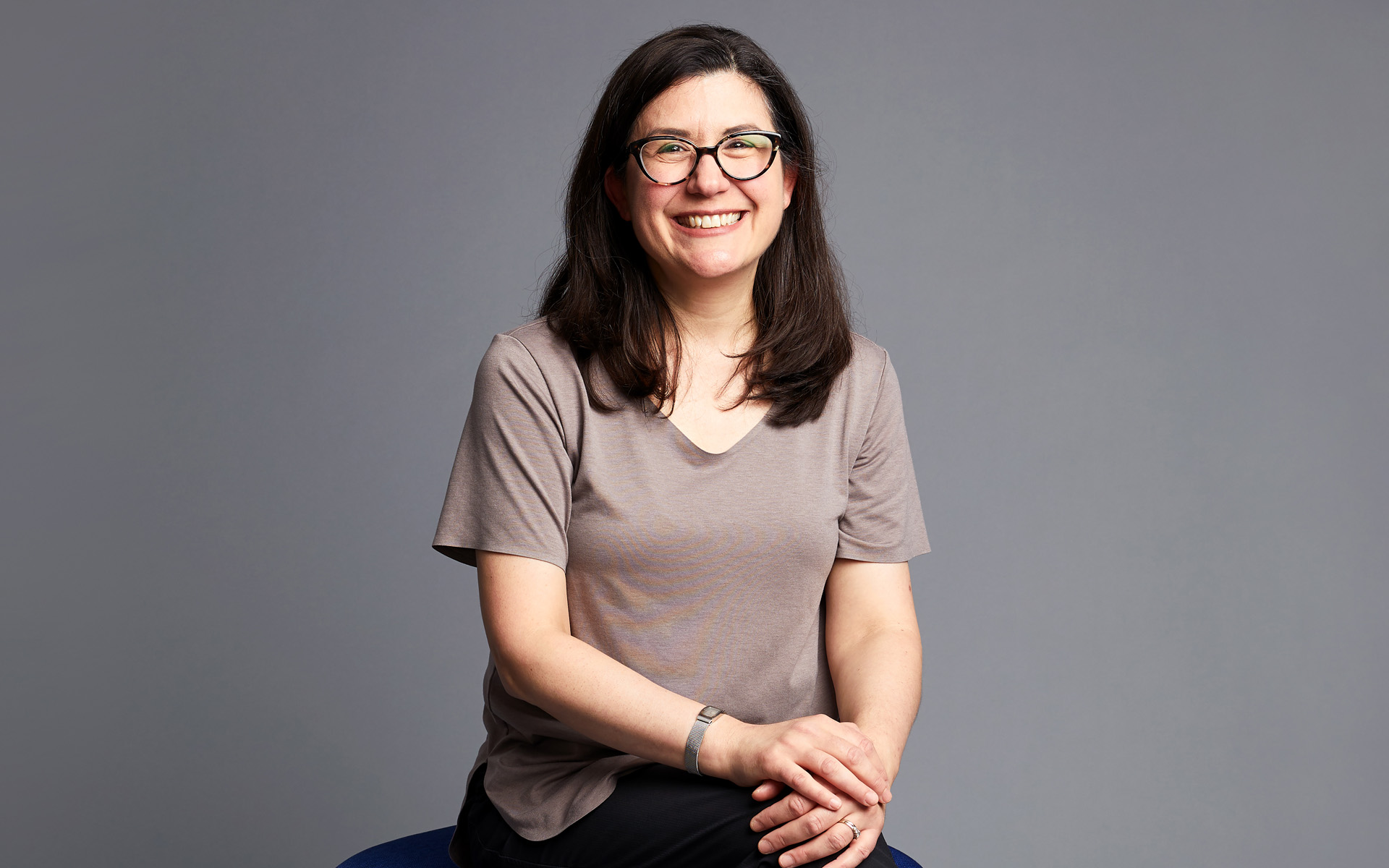
Amanda Monaco says her first experience learning guitar helped shape the way she teaches it today. Her father had played guitar in a band with his brothers when he was younger, but sold his instrument when Amanda was a toddler, figuring she’d never take up the guitar herself. He was wrong. Two days after her 12th birthday, she got her first guitar, and her delighted father wasted no time teaching her a song: “Wooly Bully” by Sam the Sham and the Pharaohs.
“The first chord is an F7 chord! It’s a barre chord that uses all four fingers, including the pinkie, to play the flat7,” she says. “It’s not an easy chord, but he didn’t know and I didn’t know! So I played it!”
Today, Monaco teaches Guitar Fundamentals, Guitar Chords 101, Guitar Chords 201, and several levels of private lessons for Berklee Online, where she brings that same willingness to tackle challenging material to her students. In the following conversation, she discusses her teenage metal years, the teachers who shaped her musical journey, her adventures onstage (and on TV), and why she believes hard work matters more than natural talent.
What is your favorite chord progression?
Amanda Monaco: I really like playing ii-V-I using 2nds, which is super stretchy, but I like the way it sounds. I had a great teacher in undergrad named Ted Dunbar. He wrote a book about the ii-V-I chord progression, and he would make us play that chord progression in 2nds, or in 4ths, 6ths, or in triads. I got used to using different intervals instead of just thinking about chords, but thinking about how the notes fit together and how they stack on top of each other.
I always try to encourage my students to think intervallically, which with all the information that we have with the guitar and with music, it can be really hard to think about the intervals.
I try to encourage that with all my students. Pretty much every jazz standard is a ii-V-I. “Satin Doll” starts with ii-V.
Tell me about some of your first professional gigs.
Amanda Monaco: My first professional gig was my sophomore year of high school, and I played in a ’50s and ’60s cover band called The Dimensions that was run by Joe Bracali. But nobody wanted to say Bracali, so he became Joe Broccoli. He was a keyboard player, and his cousin played drums. His cousin forced his girlfriend at the time to sing and she was miserable.
We had gigs every weekend. I think we played a Mafia christening once because the baby was in the little carrier and there were all these big guys in suits. The baby had like a gold chain all the way down to its feet. I’m not sure if Joe was in the Mafia or not. All I know is that after high school, I didn’t see him for like 20 years. Then I was doing these clinics at Manny’s Music in New York City and Joe walked in with this older girlfriend, who was wearing a big fur coat. Joe is now a plumber. Anyway, we had a lot of gigs and we had a lot of really good times. It was pretty outrageous. [Laughs]
We also need to talk about your metal phase. You sent us a photograph of you in your metal phase for a different Take Note article, but we didn’t end up using it at the time—we definitely will now!—but you grew up in New Jersey, right?
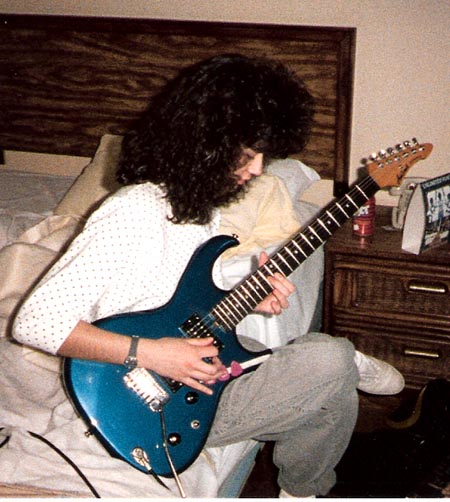
Amanda Monaco: I grew up in mid-state Connecticut, which is pretty much the same thing as New Jersey. Like East Haven, Connecticut and New Jersey, the hair was the same! The hair in East Haven can still be a little big! My metal phase was really weird. The best thing I can say about my metal phase was the hair. And I apologize for the hole in the ozone layer that I created with my big hair. But I had a string of really bad guitar teachers who didn’t know much. The pickings where I grew up was very slim. I was not a very good guitar player, but I liked metal and I had really big hair.
I was really into Van Halen in middle school, but I never really had the teachers who could help me do that. And then, I got really into jazz. I think I got really into jazz because of The Muppet Show from the ’70s. If you go back and look or listen to what they were doing, there’s a lot of jazz in there, so I thought it would be cool to play jazz.
I applied to an arts high school in my sophomore year of high school. It was like this free arts high school in New Haven. I auditioned, and this would never happen now, but they said to me, “Listen, you’re a terrible guitar player and we can’t really let you in for guitar, but we also noticed that you play the French horn. So what do you say you play French horn in the youth orchestra and we let you come in for jazz guitar?” I said “Deal,” so I played in the youth orchestra.
It was great. That’s where I met my guitar teacher, George Raccio, who is the only reason I am talking to you at this moment. He was amazing. I went from not being able to play anything to All-State Jazz Band two years later.
And do you still play the French horn?
Amanda Monaco: Very badly now. I’m playing in the Commencement concert, though!
Prior to practicing for the Commencement concert, when was the last time you picked up the French horn?
Amanda Monaco: I played it a little during the pandemic. I took some lessons on Zoom. I swapped guitar lessons with somebody for French horn lessons.
Let’s talk more about the instructor you had who you credit as the reason why you’re still playing guitar.
Amanda Monaco: George Raccio had a really simple approach to music. He also had a very thorough approach to music. He actually used a lot of Berklee textbooks with me. He used
Melodic Rhythms for Guitar and Reading Studies for Guitar. I had a jazz ensemble with him at school. The school was The Educational Center for the Arts, which is his great part-time high school in New Haven, Connecticut, where you basically go to two high schools at the same time. You go to your regular high school in the morning and then you go to ECA in the afternoon.
The first thing George made all of us do was transcribe a Miles Davis solo from Kind of Blue. After we all did that, we were broken down into groups and we transcribed all of Miles Davis’s solos on that record. We each got a part of a solo and we played a lot of that music.
Concurrent with that, were my guitar lessons. He started me off with scales and 7th chords, and taught me how to find the notes in every chord so I could build whatever chord I wanted. It was a real sort of “teaching me to fish instead of giving me a fish” kind of approach.
The thing is that if you explain something to someone—and I try to do this with all my students—if you explain it in a way that makes it accessible, it’s accessible! Kind of in the same way when my father said, “Play this big, giant F7 chord even though you’ve never played a guitar before in your life” and I was like, “I like the way that sounds!”
I didn’t think it was hard because I think there’s a lot of truth to that. In the approach of how you teach someone to do something. George was just really good at that. We just worked through stuff and then really soon after, my jazz ensemble transcribed the solos on Miles Davis’s Kind of Blue.
He gave us a Wayne Shorter album, and that was a lot more complicated, but George said we could do it, so I did it. Now that I think about it, I transcribed the second chorus on C5 like that was the second or third thing I ever transcribed. Now that I think about that, I’m like, “Whoa!” I didn’t think about it at the time, because he was so good at making things accessible.
In learning jazz, did you continue to explore the guitar for other music? Did you ever go back and figure out Eddie Van Halen stuff?
Amanda Monaco: I never really did go back to figuring out Eddie Van Halen stuff. I got really into jazz pretty quickly. I think also because of my classmates, we were always listening to different music and really digging in, and I grew up so close to New York that we would go see shows at the Village Vanguard, The Blue Note, things like that. We would always be going to clubs. I had friends whose parents were really into jazz as well. So we all used to just kind of hop on the train from New Haven to New York. It was like an hour and 50 minutes. There was a lot of that going on, and there was a lot of playing going on.
Can you remember any really special shows you got to see that changed your life or at least changed the way you play?
Amanda Monaco: I’ve been lucky that I’ve been to a lot of really good concerts. When the guitarist Jim Hall used to book a week at the Village Vanguard, I’d find out in advance because they always advertised it and I would save up my money to go. One of the concerts I saw of his was with trumpet player Tom Harrell. There’s this out-of-print Jim Hall record called These Rooms with Tom Harrell, Steve LaSpina, and Joey Baron. It’s really hard to find, but that band actually played at the Village Vanguard.
Another time I went to Sonny Rollins’s 80th birthday at Town Hall, and Jim Hall sat in, and they’d been playing together at that point for like 50 years or so. It was telepathic, almost. I remember turning to my husband and saying, “If I get hit by a bus on the way home, it’s okay.”
I accidentally was taken to see John Zorn’s Naked City, their very last gig at the very first Knitting Factory on East Houston Street. Bill Frisell, when he was still playing an SG, which I don’t know if anybody remembers. Yeah, just a lot of shows. I saw Herbie Hancock play Maiden Voyage. I’ve been very lucky. I’ve been to a lot of really good shows.
Tell us a little bit about how you started teaching with Berklee Online because you had been teaching on campus for a while before you came to teach here.
Amanda Monaco: My first experience of teaching was actually at a place called the National Guitar Workshop in Connecticut. They actually had a pedagogy program and an intern program. I took that for a couple of years, and then I started teaching there when I was 20. I was teaching there every summer. I had private students in New York City. Then in 2001, I was a student at the Banff Center for the Arts in Canada. My guitar teacher was Rick Peckham, who is the author of Guitar Chords 101 and of Guitar Chords 201. He was the assistant chair of Berklee at the time. I studied with him and he knew I was a teacher and we kept in touch. Then I started teaching guitar sessions in Boston in the summer of 2004. When I got my master’s degree, I let Rick know and then I did my first Five-Week program in 2011. I joined the faculty in Boston in September of 2011, and I started Berklee Online in 2016.
At what point did you realize you had enough knowledge to share with students?
Amanda Monaco: I started teaching guitar in my junior year of high school. My first student was the college quarterback. He didn’t have hands. He had paws. But somehow I had a positive attitude when he’s like, “I don’t know if I can play this chord.” I was like, “You can do it, you can do it.” And I was like [under my breath], “I don’t know if he can really do it.” But I got him to do it!
So I was like, “Oh, I’m really good. I got him to do it.” I just started with that and then I started going to the National Guitar Workshop as a student in 1989, and I saw how they were teaching things and I had a lot of really good teachers there who I’m actually still friends with now because they weren’t that old when they were teaching. Actually, my first teacher at the National Guitar Workshop—I took Rock Level II with Jeff McClain, who went to Berklee—I think he was actually going to Berklee at the time he was teaching there. We’re still in touch. There are a lot of people who taught there that I’m still in touch with, including Kim Perlak, the chair of the guitar department. Sheryl Bailey also taught there. She’s the assistant chair of the Guitar department. Freddie Bryant, who’s on the faculty band. I’m forgetting a few of the other names, but a lot of people taught there that now teach at Berklee.
Describe your teaching philosophy.
Amanda Monaco: My teaching philosophy is to keep it simple. I also truly believe that you need to know the notes on the fretboard. Many people think they can get around that with shapes. You can’t do that. You have to know where the notes are, and there are so many interesting ways that you can do that. You can solo on one string, you can take the shapes and say what the notes are, you can improvise on one string. That’s what the great Mick Goodrick—who was one of the most important people in the Guitar department—he, in his book, The Advancing Guitarist, talks about soloing on one string. If you do that, you’re keeping it very simple and it’s hard to play licks on one string. I also tell all of my students there’s definitely a memorization component. It’s like learning your multiplication tables. And I know that most people don’t remember what it was like to learn their multiplication tables, but there’s so much of it that’s just rote and just repetition. People don’t realize that repetition is important. They’re like, “Well, I can just do this now.” It’s like, “Well, okay, but you’re going to hit a wall eventually.” So I just tell them that it’s not difficult, it’s unfamiliar. So familiarize yourself with it and just play consistently. Repeat things, do everything forwards and backwards. That’s what the scales are like. A lot of times people just play scales one way. I’ll tell them to name the notes as you go up and then name them going down. The backwards thing kind of throws people off. So I just tell them they have to do that.
How do you identify potential in somebody, whether it’s the football player with the big hands or a student who’s Zooming in from a country where guitars aren’t widely accessible?
Amanda Monaco: I get in trouble for this a lot, but I’m not a big believer in talent. I’m a huge believer in hard work, and anybody can work hard. I’ve seen it happen. I’ve had students who are super-talented and they don’t do the work. They hit the wall, and then you’ve got the kid over here or the adult over here that wants it so badly that they work and work and work, and the sky’s the limit. It’s really just how much you are willing to work. That’s it! It’s not as glamorous as talent, but it’s the truth.
I’d be remiss if I didn’t ask you about your appearances on television. You were on the show Cash Cab and on a commercial for Chili’s.
Amanda Monaco: That was one of my more embarrassing moments, the Cash Cab thing. They tricked us. They tricked us into being on there. They told us it was about something else. I was pissed. Because I put my guitar down, and I was like, “I put on makeup and left the house for this?”
Anyway, I was in an all-girl band called the Lascivious Biddies, which means the dirty old ladies. It was a great band and it was totally unsustainable. I’m the only one still on the same path! The lead singer is an occupational therapist now. The bassist is doing music still, but also this really amazing puppetry stuff. I don’t know what happened to the pianist. We don’t talk. But we auditioned for a Chili’s commercial and we had to do two different arrangements of the “Baby Back Ribs” song, which we did, and we got flown out to California and we did the commercial. Our lawyer looked at the contract, and it was actually legit. That’s why we were only on TV for six weeks, because they actually had to pay us, but it was fun.
They paid you every time it aired?
Amanda Monaco: We each made like seven grand in six weeks, which is what it’s supposed to be. We had a really good lawyer. We had a really good lawyer because the lead singer’s landlord had a really good lawyer. He was also married to Kathleen Turner, who used to come and sit in the back of my gigs and talk really loud. I taught their kid guitar. I should have kept one of the checks! They just said “Kathleen Turner” on them. She was really lovely. It was his lawyer who I think had a band called The Suits. So that’s why we had a really good lawyer. It’s also the reason why we didn’t go on America’s Got Talent. Because if you see that contract, that contract is terrifying! It says if you sign that contract and you talk about it and they find out, it says in the contract you owe NBC [a lot of money]!
The thing with Cash Cab is that it was supposed to be a TV show about where artists go for fun and inspiration. They said they were going to put us in a car and then the car never came. So they said, “Oh, we’ll just put you in this cab.” Then I got called to do game shows for six months, and I’m like, “I don’t want to do game shows. Stop calling me.”
I understand the person you’re married to has a job that’s connected to music in a very different way.
Amanda Monaco: My husband owned a newspaper for 20 years called the New York City Jazz Record. Now he writes jazz obituaries; jazzpassings.com is his website.
He also writes advanced jazz obituaries for the New York Times. He has had some of them published. Then he is also a spinning instructor. He also writes for Jazz Times and Brooklyn Rail and a bunch of other publications.
So, he’s a jazz guy, but he’s also really into metal. He’s always really liked metal because the neighborhood kids used to take him to metal shows starting when he was seven. They thought it would be hilarious to take a seven-year-old to see Slayer, and his parents didn’t know. His parents didn’t know they had just emigrated from the Soviet Union, all three of them.
My husband has had stories where he’s been like, “Hey, your friend who hasn’t died yet, but he’s going to die at some point, I’m writing his obituary, and I’m wondering if I could get a quote from you.” And he’s gotten answers ranging from, “Yeah, sure!” to “Can we wait until he leaves the bandstand before I talk to you? Because I just can’t …” It’s really weird. There’s this one person—and I won’t name who they are—but their obituary has been written for like 25 years now, and they’re just like, “I’ll just keep adding to it.” I mean, do you really think Queen Elizabeth’s obituary was written in a day? That was around for at least 40 years.
Okay, so while we’re on the topic of death, I need you to tell me about Deathblow.
Amanda Monaco: So I got a deal with this Japanese record label because they wanted a female jazz guitarist. A good buddy of mine from college was like, “Oh, you should call Amanda Monaco,” and so they did. It was a new band, totally different musicians from my first two quartet records. I said to my husband, “What should I call it?” He’s like “Deathblow.” I said, “Why?” He said, ‘Well, why not?” I said, “Well, it has nothing to do with anything.” He said, “I know.” So it just stuck and it’s become like this big joke.
We made another record. My cousin’s kid did the artwork. She’s 13 years old. I cannot believe she did this. She’s also going to the Arts High School that I went to. And her older brother is a drummer and is auditioning for Berklee in the fall.
How do you choose and prioritize what musical projects you’re going to do?
Amanda Monaco: I try not to do more than three things at a time. That’s sort of what somebody told me a long time ago. I play a Klein guitar, which is a kind of wacky-looking guitar. It looks like a kidney on a stick. In 2002, there was a guy who owned a recording studio in New York City who wanted to try it, and he was like a record producer. I don’t even remember his name, which was poor on my part because it’s a connection I probably should get. I remember he tried the guitar and then all of a sudden he just started giving me all this advice, and he’s like, “Don’t do more than three things at a time.” And I was like, “Yeah, okay.” I’ve seen that in other spots, like people have said “don’t do more than three things at a time.” So right now it’s like teaching and Deathblow. I have another quartet with Hammond Organ and baritone sax that I’m doing some stuff with called Glitter, and trying to get gigs for that. We have a gig coming up in New York. Those are the three things I’m kind of focused on right now.
The Klein guitar—or the kidney on a stick, as you call it—is that your main guitar? Do you have other favorite guitars?
Amanda Monaco: So the two guitars that I play are the Klein Electric, and that’s more for like, avant-garde stuff. I use it in my Berklee Online lessons, especially in my Guitar Fundamentals class. The thing is that because the guitar is ergonomic, I can show them exactly where the neck is supposed to be. I use this guitar online a lot of the time because if you notice where the neck is, the neck is actually angled where the neck is supposed to be angled without me having to cross my legs and contort my torso.
I also play a Brian Moore DC/1. It’s a thinline, hollow-body with E holes, not F holes, which I actually have because my former landlord—Kathleen Turner’s ex-husband—had a stake in the company. That’s how I got the guitar. I got an endorsement with them, which is why I was at Manny’s doing music demos, and I ran into Joe Broccoli and his older girlfriend with the big fur coat. So I’ve been playing that guitar for 20 years now.