Sean Slade helped shape the sound of ’90s alt-rock, from Boston’s Fort Apache studio to Radiohead’s breakout hit “Creep.” In this Q&A, he shares the stories, instincts, and creative risks behind those sessions, along with the lessons that continue to guide his work as a producer and educator, teaching in Berklee Online’s Music Production grad program.
As a musician, not all of your practice will be on your instrument. Some of it will be in your head, and some of it may even be on objects that just look like your instrument. We call this mental practice, and in this excerpt from Barbara LaFitte’s Practicing Techniques for Musicians course, the former principal oboist in the Boston Ballet Orchestra shares tips on how to practice your instrument when you just aren’t able to actually play your instrument.
Wondering where to take your music career? Explore the best cities for your professional life through expert advice from Berklee Online instructors and alums who currently live and work in Nashville, Los Angeles, New York City, and Miami.
Cindy Blackman became Lenny Kravitz’s drummer after a lifetime of jazz drumming. In this wide-ranging interview she discusses being visited by the spirits of the jazz greats she befriended during her time in New York City, and how she and husband Carlos Santana stay in harmony, onstage and off.
How a Netflix Kids Film Made K-Pop’s Summer Anthem and Won New Fans
In summer 2025, music headlines from outlets like NPR,The Guardian, and CNN question whether there’s a true song of the summer. Even Berklee’s Joe Bennett weighs in. However, the music from the animated children’s movie KPop Demon Hunters might just be the answer. Since the film’s release on Netflix in June, the songs from the soundtrack have continued to climb the Billboard Hot 100 charts. By mid-August, the song “Golden,” performed by the film’s fictional K-Pop group HUNTR/X, was sitting at No. 1.
The song “Golden” from KPop Demon Hunters, which reached No. 1 on the Billboard Hot 100.
“It’s a very interesting phenomenon,” says Dr. Ray Seol, a K-Pop expert at Berklee who is teaching a virtual masterclass on September 18 called K-Pop and Beyond: The Rise of a Global Sensation. “We all know K-Pop as a musical genre from Korea. We’ve been enjoying many idol groups. But this is a unique one: This is animation. I watched it a couple of times because I wanted to understand the content on a deeper level. They did a really good job on historical facts and analysis of Korean culture, and how it relates to the actual entertainment industry.”
K-Pop fan Emi Faucher, a 12-year-old actor who was recently seen as young Snow White in the new Disney live-action remake, says she heard about KPop Demon Hunters from her friends who have streamed the movie upwards of 10 times.
“K-Pop fans are very dedicated,” says Faucher. “When we all heard the soundtrack, everybody was like, ‘Oh, yeah, this is really cool,’ because they included Korean in it, and they included the same kind of catchy beats you would hear in K-Pop music. And I think we just kind of fell in love with the soundtrack.”
The film’s fandom has expanded well beyond its tween target audience, resonating with viewers of all ages. In his upcoming masterclass, Seol plans to discuss the cultural impact of KPop Demon Hunters and how it could indicate where the genre is headed.
What Is KPop Demon Hunters About?
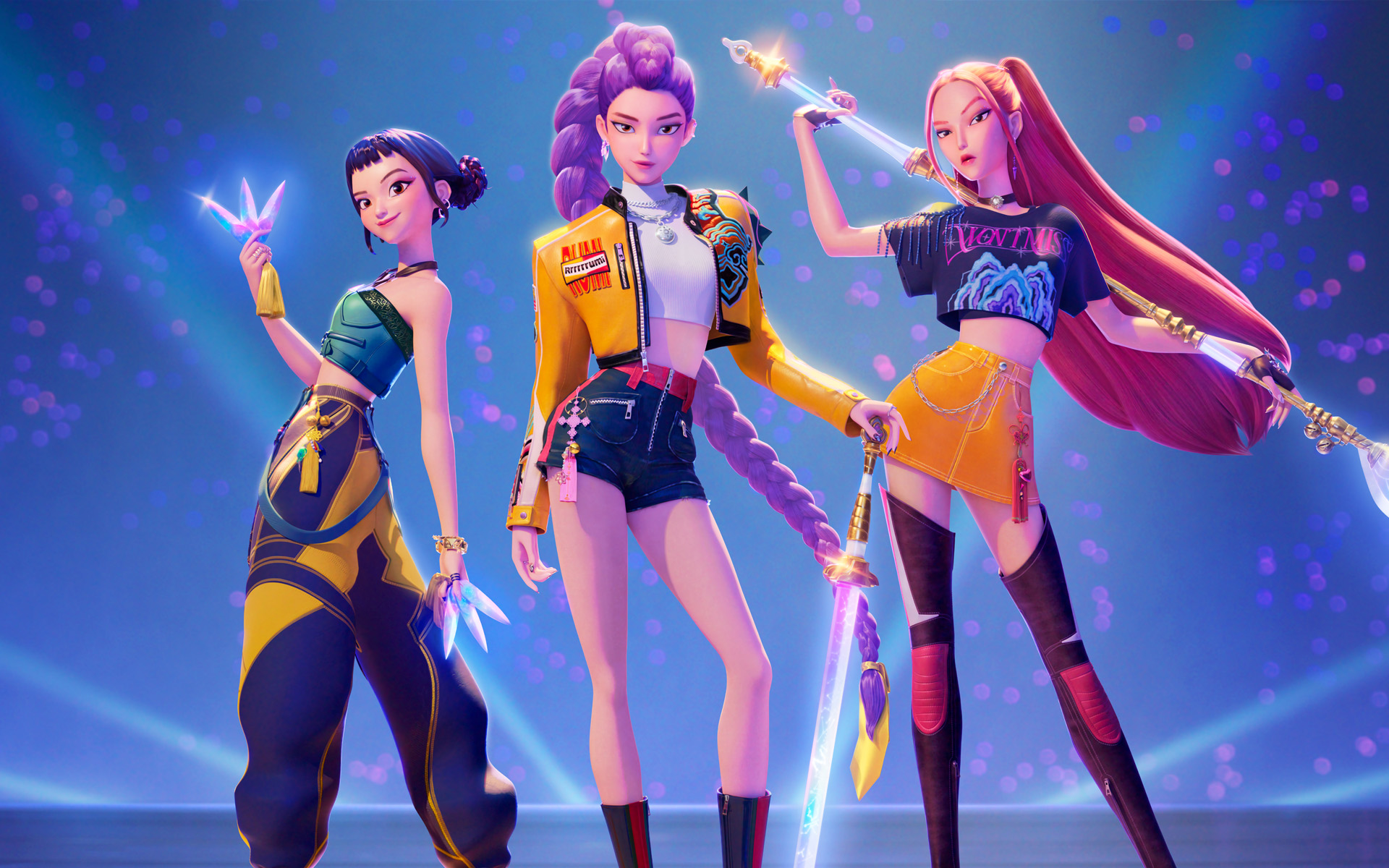
KPop Demon Hunters is about a K-Pop group—the aforementioned HUNTR/X—made up of characters Rumi, Mira, and Zoey. Not only do they sell out stadiums, but (as the movie’s title implies) they also fight demons. What complicates matters is that lead singer Rumi is half-demon herself, keeping this secret from her bandmates. When an all-demon group called the Saja Boys comes on the scene, the HUNTR/X women need to save the souls of their fans, while also coming to terms with Rumi’s identity.
The trailer of Netflix’s KPop Demon Hunters movie.
Seol points out that the film is a US production, co-directed by Maggie Kang, who is Korean-Canadian, and produced by an American animation studio owned by Sony, which is a Japanese company. He says that this blend of input could be one of the reasons why the film is attracting new fans to K-Pop, while also receiving approval from K-Pop fans and Korean viewers.
“I think her background plays a role in delving really deep into the cultural aspects, and also reaching a balance between Western and Eastern culture,” says Seol about Kang.
Mythology
One of the cultural aspects that Seol is referring to is the film’s exploration of Korean mythology. As it turns out, a story about women using music to protect people from demons is nothing new.
“With the mythology, we wanted to root it in something that existed in Korean culture already. What it is, is Korean Shamanism,” said Kang in an interview with Salon. “Historically, Korean shamans are mostly women, which was kind of perfect for us.”
The HUNTR/X women represent shamans, or Mudang, who use song, dance, and ritual to ward off evil, while the Saja Boys are based on Jeoseung saja, which are Grim Reaper-like figures. Other non-idol demons include Dokkaebi, who are trickster goblins.
“In Korea, in the thirteenth century, people since then rely on some Shamanism ritual for defeating demons,” says Seol. “There’s a religious understanding, and we do actually have dancing and songs.”
Tiger & Magpie – Hojak-do
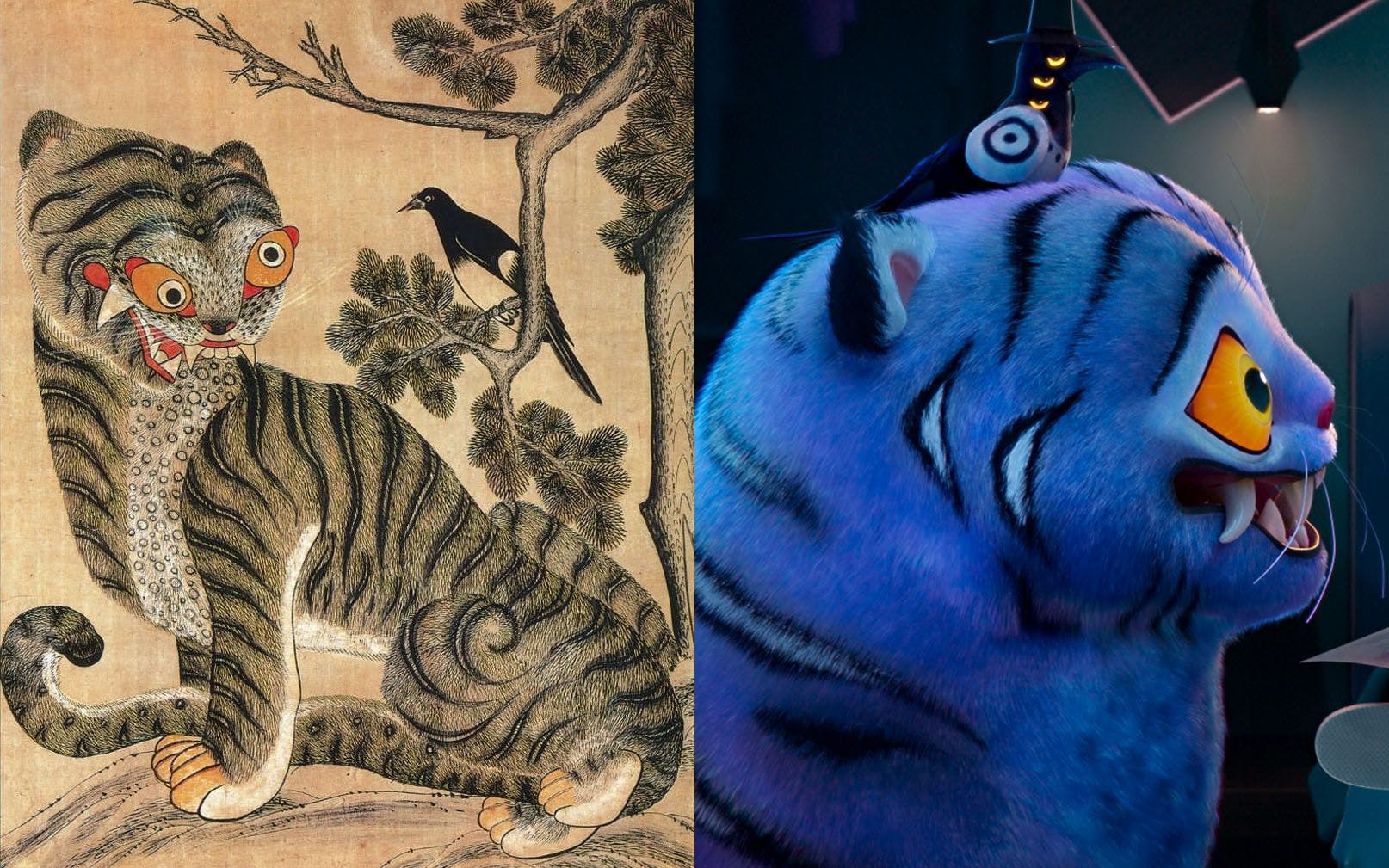
Another mythological touchstone in the film is the tiger and magpie bird, which appear as sidekick characters. Seol notes that this duo is a reference to Hojak-do, which is a style of Korean folk art that goes back more than a thousand years called Minhwa.
“We love both animals—the tiger, obviously a big, strong, powerful figure, and everybody loves and is also afraid of seeing them,” says Seol. “And the little blackbird is very sly and smart. Korean people, when we see it, we immediately go, ‘Wow!’ because that’s something we all know.”
The tiger serves as comic relief, despite being a fierce animal, which is typical in Hojak-do.
“The tiger looks a little stupid intentionally, because people are afraid of tigers,” says Seol. “In the animation and traditional painting, they always express the tiger as a funny figure. Which is not true. So they really did a great job on delivering the message.”
Depiction of Idols
The film also offers a glimpse into the everyday lives of idols, portraying them not just as celebrities, but as regular people. We see this throughout the movie as the three HUNTR/X women attempt to have a relaxing week off to visit the spa, wear comfy clothes, and sit on the couch playing video games, which becomes a tagline of the movie (“Couch! Couch! Couch!). Google “KPop Demon Hunters” and you’ll see! This choice reflects the broader trend of K-Pop idols sharing more about their personal lives.
“It’s very relaxed [the portrayal] and sort of like the backstage of celebrity life as an idol,” says Seol. “They show them as being everyday folks. It is very wise and smart marketing for the idol these days.”
Typically, the lives of K-Pop idols are very secretive, and fans don’t get to see what happens behind the scenes. This started changing around 2013, when the group BTS started sharing day-in-the-life videos on YouTube, giving fans a window into their lives and creating even more of a connection.
“Let’s say, for example, BLACKPINK; If they do some sort of big show, we don’t know what they do afterwards,” says Seol. “But maybe it’s similar; They’re eating ramen, maybe they’re playing video games. It makes them very friendly, and lets us come close to their world.”
Ramen
KPop Demon Hunters images courtesy of Netflix.
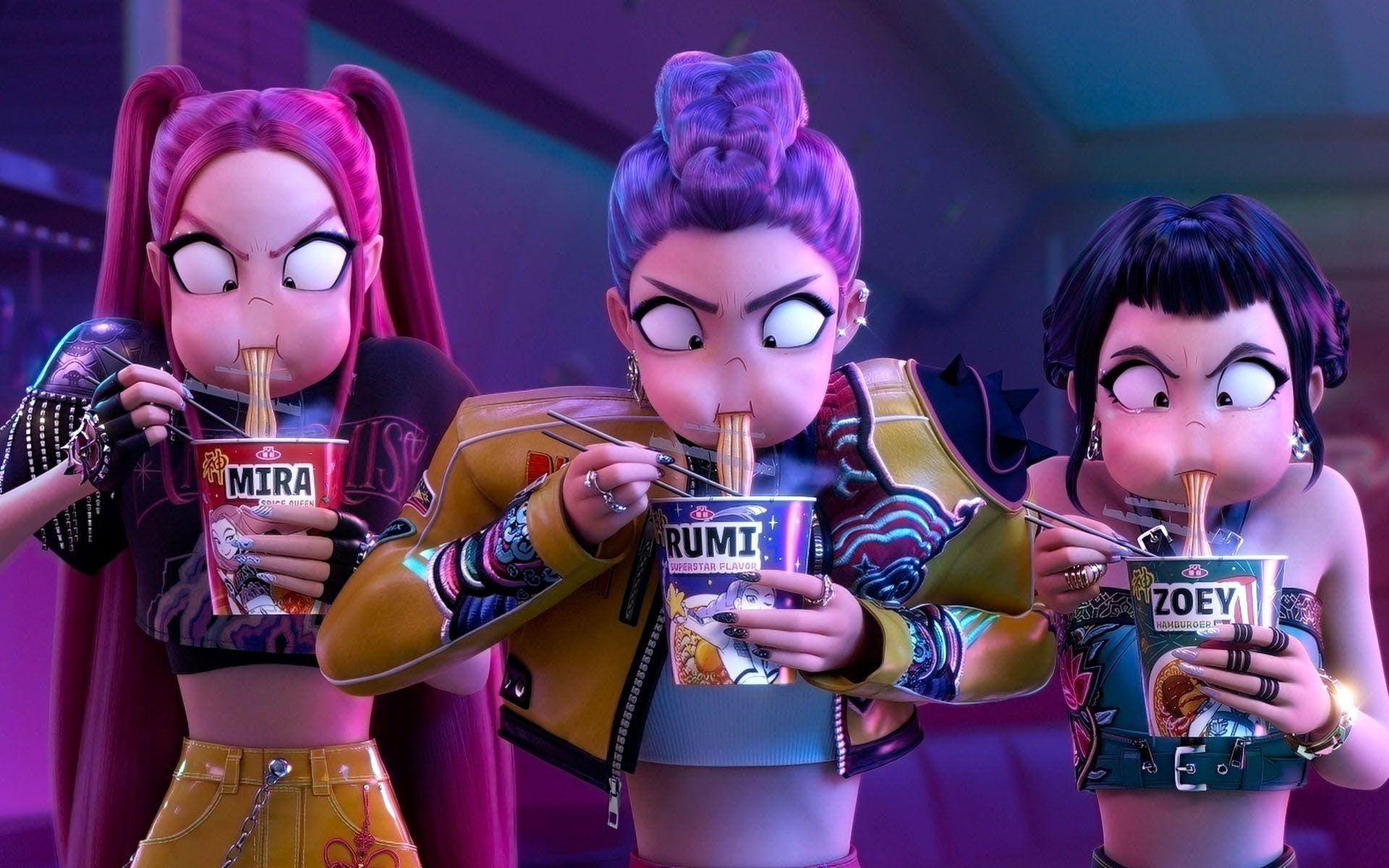
Going hand-in-hand with the behind-the-scenes life of an idol, the HUNTR/X women love to eat. The K-Pop industry is notorious for pushing extreme dieting and exercise, and this portrayal sends a strong message that delighting in food is a good thing and gives you energy to fight demons.
One of the foods they enjoy is instant ramen, and Seol points out that this $2 treat shows that they have a closeness or bond. He says that this is the case with his 17-year-old daughter.
“Whenever she does something good, we celebrate by eating instant ramen,” says Seol about his daughter. “So whenever I saw them [the HUNTR/X women] eating ramen, it was a very important scene. That type of sharing and time of eating together with that cheap, instant ramen, means a lot as a family, and as friends.”
What to Listen to Next
For people who enjoyed KPop Demon Hunters and want to know what to listen to next, Seol says he gets this question a lot from his students:
“I always have a group of students who ask me a question about, ‘I want to hear actual Korean pop. I don’t want to hear the K-Pop that’s made for us. I want to hear the K-Pop they made for you.’
He says that there is a distinction between “K-Pop,” which is marketed internationally, and what he calls “Korean pop song,” which is written by Korean artists, for Korean artists called Gayo.
“I want them to find out what Korean people are actually listening to and then try to love that,” says Seol. “Gayo, that’s for Korean people, and it’s very charming, very well made. So I think people should try to find a way to discover the Korean songs that are loved by Korean people in Korea.”
Seol recommends Berklee alum Kim Dong-ryul.
Berklee alum Kim Dong-ryul, who Seol considers a Gayo artist.
“Any song that you pick from Kim Dong-ryul is like a masterpiece,” he says. “Me and my wife absolutely love him. His tickets sell in like a second.”
The Future of K-Pop
As summer in the US comes to an end, the KPop Demon Hunters phenomenon shows no signs of slowing down. In early August, the K-Pop group TWICE performed “TAKEDOWN” from the film’s soundtrack at Lollapalooza in Chicago. Not only were they met with an exuberant fan reaction, but they were the first K-Pop girl group to headline the festival. Also, a sing-along version of the film hit theaters and brought in nearly $20 million in ticket revenue. On Netflix, the movie has officially become the most-streamed animated movie in the platform’s history. Some are saying it could be the next Frozen franchise.
K-Pop group TWICE performing the song “TAKEDOWN” from KPop Demon Hunters at Lollapalooza.
For Seol, the film’s success points to the evolution of K-Pop itself, and he plans to explore this in depth in his upcoming masterclass.
“The future of K-Pop has been a very serious question for a while,” says Seol. “My true wish, as a Korean professor at Berklee, is that K-Pop becomes a culture, like hip-hop or Latin music, that people are trying to learn and preserve. I’d love to see that. K-Pop can be consumed and made outside of Korea as a culture, so that it represents not only Korean people, but also people worldwide who want to have their own voice.”