






Who Are ‘You’? Examples from Dolly Parton, Billie Eilish, and More Show How Direct Address Shapes a Song
The following information on direct address in songwriting is excerpted from the Berklee Online course Lyric Writing 2, written by Erin Chase, and currently enrolling.
Some songs feel more like conversations than stories. Instead of describing a relationship from the outside, this type of song can place us directly inside it—between an “I” and a “you.” Songwriters call this technique direct address, and it’s one of the most effective ways to create intimacy, tension, and emotional immediacy in a lyric.
Direct address places the lyric inside a moment of communication between the aforementioned “I” and “you.” Rather than observing from the outside (third person) or guiding a subject from a distance (second person), direct address creates an unfolding relationship. Instead of interpreting or instructing from afar, the narrator is speaking to someone directly, injecting that conversation with emotional stakes, vulnerability, or urgency.
One of the benefits of using direct address in a song is that it bridges the gap between private thought and a shared emotional experience, transforming a song into a live conversation. While first-person narrative pulls us into a private consciousness and second-person narrative often places the listener directly into the role of the protagonist, direct address shifts the focus to a specific relationship.
A Lyrical Look: ‘Fever’
Never know how much I love you
Never know how much I care
When you put your arms around me
I get a fever that’s so hard to bear
You give me fever
—From “Fever,” written by John Davenport and Eddie J. Cooley, originally recorded by Little Willie John
Take a look at the lines above. In this style of lyric-writing, the speaker doesn’t describe love from a distance. They speak directly to the one who ignites the flame. This repeated “you” anchors the song in a relationship, turning an abstract feeling into a shared experience. This immediacy is the core strength of direct address: it places the listener inside a moment of active communication.
Advantages of Direct Address Songwriting
Direct address places the listener inside a relationship, shaping the lyric through interaction, emotion, and perspective.
- Emotional intimacy: Because the lyric is spoken directly to someone, it creates a sense of closeness and vulnerability. The listener may feel like they are overhearing, or even participating in, a private moment.
- Immediate stakes: There is always something at risk in direct address, whether it is connection, disconnection, understanding, or conflict. The presence of a “you” creates built-in emotional tension.
- Authentic voice: Direct address often mirrors natural speech patterns—confessions, arguments, questions, or pleas—which can make lyrics feel conversational and grounded.
- Dynamic relationship building: The interaction between “I” and “you” allows you to develop character, history, and emotional shifts through dialogue, implication, and response.
- Subtext and interpretation: Because the speaker does not fully know the “you,” meaning can live beneath the surface. What is left unsaid can be just as powerful as what is spoken.
Limitations of Direct Address
The same qualities that make direct address powerful also create specific technical constraints.
- Limited knowledge: The narrator only has access to their own perspective. They cannot definitively explain the thoughts or motivations of the “you” character without it feeling assumptive or forced.
- Risk of vagueness: If the relationship between “I” and “you” is not clearly defined, the lyric may feel unfocused or emotionally unclear to the audience.
- Over-reliance on general statements: Without specific detail, direct address can easily fall into clichés or broad emotional language that lacks a unique narrative impact.
- Balance of voice: You must carefully manage how much space is given to “I” vs. “you.” Some lyrics benefit from leaning heavily toward one perspective, while others require a balanced distribution to serve the song’s emotional movement.
Direct Address in the Song ‘Fever’
Catching ‘Fever’: Little Willie John’s Original Burn
While Little Willie John’s original recording introduced the song in 1956, many listeners know
“Fever” through later (and more popular) versions by artists such as
Peggy Lee
(whose version had 215.1 million streams at the time of this writing),
Elvis
(36.8 M),
The Cramps
(10.1 M),
Madonna
(9.1 M), and
Beyoncé
(7.6 M). Incidentally, this may be the only metric where The Cramps have more streams than Madonna and Beyoncé. This Little Willie original version from 1956 had 7.7 million Spotify streams on the day this article was published.
In the lyrics, which we glimpsed at the beginning of this article, direct address does the emotional work in “Fever.” The speaker isn’t reflecting on love from a distance or interpreting someone else’s experience—they are speaking directly to the person who causes the feeling. This choice creates a sense of immediacy where lines like “Listen to me, baby / Hear every word I say” feel as if they are happening in the moment. The lyric is a live exchange, which makes the emotion feel present rather than retrospective.
The song creates a sense of closeness by narrowing the focus to a single, shared space. Even without knowing the specific history of the couple, the constant attention on the subject makes the listener feel like a fly on the wall during a private encounter.
Ultimately, direct address turns the song into a conversation rather than a report. It builds intimacy through repetition and proximity, making the listener feel like they are inside the room where the words are being spoken.
The strength of this perspective lies in its natural limitations. Because the narrator is stuck in their own head, they can’t truly know what the other person is thinking. This creates a built-in tension where the meaning of the song often lives in the gaps—the guesses, the assumptions, and the things left unsaid. It forces the listener to lean in and feel the weight of a conversation where the stakes are immediate.
How Direct Address Creates a Sense of Intimacy Through Limited Knowledge
In direct address, a narrator operates from a place of limited knowledge while simultaneously creating a sense of intimacy. This is one of the most delicate balances in songwriting. You are standing inside a relationship, speaking directly to another person, yet you lack access to their internal world. You only know what you see, what you feel, and what you believe.
This limitation is a creative tool rather than a weakness. When a narrator doesn’t fully understand the “you,” it opens the door for tension and subtext.
Focusing on observable behavior—what the “you” character actually does or doesn’t do—invites the listener to help make sense of the story. Rather than being told an objective truth, the audience interprets the relationship alongside the narrator. When you write from this perspective, you lean on specific moments and emotional reactions.
The simple use of “you” places the listener inside the interaction, making the lyric feel personal and immediate.This intimacy is built through vulnerability. Confessions, terms of endearment, and a conversational tone all bridge the gap between the two characters. Paradoxically, uncertainty often deepens this connection. A question like, “Do you even hear me when I say your name?” reveals a specific kind of longing. The narrator’s struggle to understand the “you” is exactly what pulls the listener closer into the moment.
A Lyrical Look: ‘Sober and Skinny’
But in a perfect world,
You get sober, I get skinny
We live off of more than pennies
Writing checks that we can cash, keeping all our promises
We got faith, we got each other
We grow up and we get better
Things need fixing, we got plenty
When you get sober, I’ll get skinny
When you get sober, I’ll get skinny
—From “Sober & Skinny,” performed by Brittney Spencer and written by Jason Bradford Reeves, Danelle Leverett Reeves, and Brittney Spencer
The song “Sober & Skinny” is a potent example of using direct address to navigate a complicated relationship.
This lyric uses direct address to create a dynamic interplay of questioning, intimacy, and limited knowledge within a single relational frame. The narrator speaks directly to a “you,” which immediately establishes closeness and emotional stakes.
The narrator operates from a place of limited knowledge, especially regarding the future and the other person’s ability to change. The repeated conditional framing—“in a perfect world” vs. “in an honest world”—highlights the gap between hope and reality, showing that the narrator can imagine outcomes but cannot guarantee them.
Because direct address mirrors the way people actually speak, it often leans toward a conversational tone. This can make a song feel natural and accessible, but effective songwriting requires more than just writing “like you talk.” It requires finding a balance between the casual nature of a conversation and the depth of poetic description.
Consider this stanza:
A Lyrical Look: ‘The Night We Met’
Oh, take me back to the night we met
When the night was full of terrors
And your eyes were filled with tears
When you had not touched me yet
Oh, take me back to the night we met
—From “The Night We Met,” performed by Lord Huron and written by Ben Schneider
The first line feels conversational and immediate. The second, third, and fourth lines introduce imagery and expand the emotional landscape, allowing that sensory detail to recolor the repeated “tell” in the fifth line.
A Lyrical Look: ‘River’
Dip me in your smooth water
As I go in
As a man with many crimes, come up for air
As my sins flow down the Jordan
Oh, I wanna come near and give you
Every part of me
But there’s blood on my hands
And my lips are unclean
“River”—performed by Leon Bridges and written by Austin Michael Jenkins, Chris Vivion, Joshua Block, and Todd Bridges (a.k.a. Leon Bridges)—provides another example.
These lines strike a balance by anchoring emotional intent in simple, legible statements. Lines like “Oh, I wanna come near and give you / Every part of me” and “I wanna go / I wanna know” function as the conversational core. They are plain and direct. In contrast, the surrounding imagery—dipping into “smooth water,” “sins flow down the Jordan,” and “blood on my hands”—uses metaphor to deepen the speaker’s internal state.
Great direct-address writing lives in the space between what is said and what is shown. Looking specifically at lyrics like these helps you develop a narrator who sounds like a real person but speaks with the resonance of a songwriter.
By embracing the fact that you have limited knowledge of the other person, you create a natural space for tension, discovery, and emotional truth. By leaning into intimacy, you make the listener feel connected to the exchange. When you balance a conversational tone with descriptive language, you ensure the lyric feels both authentic and compelling.
Character Focus in Direct Address Songwriting
The ‘I’ Character
Focusing on the “I” character allows you to explore internal emotions, personal stakes, and the narrator’s specific interpretation of events. This perspective creates intimacy by letting the listener inside the speaker’s experience. However, spending too much time exclusively in the “I” can shift the lyric away from an interaction and toward an internal monologue. When the “you” becomes less active, the relationship can feel less immediate.
Take, for example, “Sugar” performed by Stevie Wonder:
A Lyrical Look: ‘Sugar’
Sugar, Sugar
How I wanna be your main boy
Sugar, Sugar
How I wanna be your play toy
—From “Sugar,” performed by Stevie Wonder and written by Don Hunter and Stevie Wonder
This focus on “I” creates intimacy by placing the listener inside the narrator’s mindset. The “you” character remains lightly sketched, existing mainly as the object of desire. This keeps the spotlight on the narrator’s confidence and sense of self. It is an effective approach because the song’s energy depends on the narrator’s point of view.
The ‘You’ Character
Focusing on the “you” character shifts the attention outward. This approach allows a writer to define the relationship through observation, highlighting specific behaviors, actions, or even a noticeable absence. By focusing on the “you,” the songwriter gives shape to the world the narrator is responding to, which can pull the listener directly into the lyric and increase the sense of immediacy.
However, leaning too heavily on the “you” without grounding the song in the “I” can backfire. Without the narrator’s emotional context, the lyric may start to feel distant or purely accusatory, losing the depth that comes from a personal perspective.
Take, for example, “Jolene,” performed and written by Dolly Parton.
A Lyrical Look: ‘Jolene’
Jolene, Jolene, Jolene, Jolene
I’m begging of you please don’t take my man
Jolene, Jolene, Jolene, Jolene
Please don’t take him even though you can
Jolene, Jolene
—From “Jolene,” written and performed by Dolly Parton
This lyric centers the “you” character—Jolene—as the driving force of the song, using her presence to shape the relationship and the emotional stakes. The use of “you” gives shape to the narrator’s emotional world. Jolene becomes the lens through which we understand the speaker’s vulnerability and desperation. Lines like “My happiness depends on you” show exactly how the narrator is affected by Jolene’s potential actions. While the song leans heavily on the “you,” it works because it is consistently grounded in the narrator’s fear and love. It never feels distant; instead, it becomes an urgent appeal that pulls the listener into the conversation, intensifying both identification and immediacy.
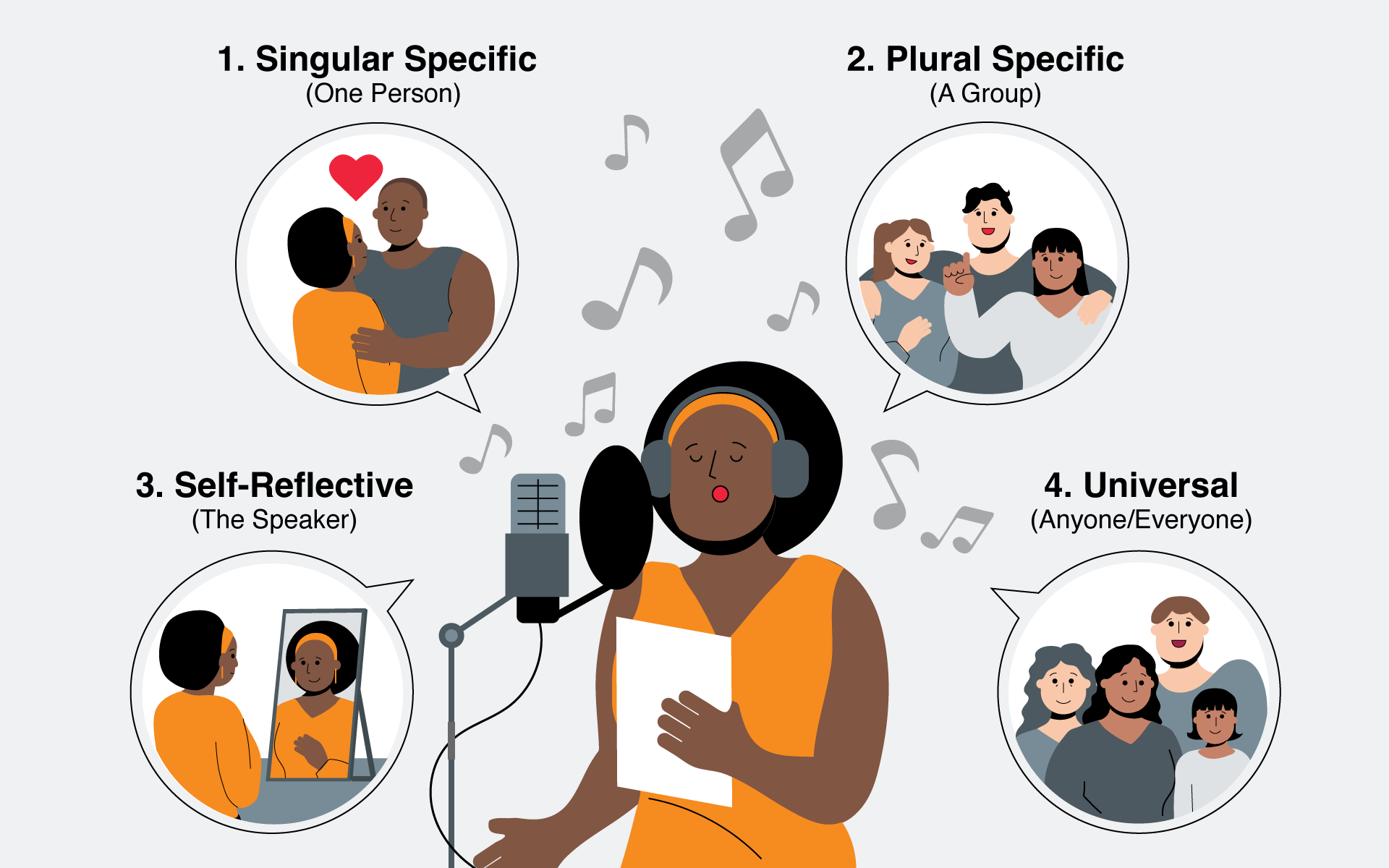
The Four Types of ‘You’ in Direct Address
- Singular specific: This is a clearly defined individual within the world of the song. It creates a high level of intimacy and urgency, making the lyric feel like a personal, private exchange.
- Plural specific: Here, the narrator addresses a defined group, such as a family, a crowd, or a community. This choice broadens the scope of the song, suggesting a collective message or a shared experience.
- Self-reflective: This is a version of “you” where the narrator is actually speaking to themselves. It introduces a layer of introspection, revealing that the song is an internal conversation caught in the speaker’s own mind.
- Universal: This version represents a broader, more inclusive human experience. It opens the lyric outward, allowing the message to resonate as a general truth that anyone might feel.
In direct address, the type of “you” you choose defines why the song is being spoken in the first place. Each choice reframes the listener’s role and reveals whether the purpose of the lyric is to connect, confront, process, or generalize an experience. When you are deciding where to place your character focus, it helps to ask who exactly is being addressed in that moment, whether that identity remains consistent, and how that choice dictates the space “you” occupies in the song.
Time for YOU to Take a Quiz About ‘You’!
Listen to the following song samples, study the lyrics, and determine which “you” the songwriter is employing.
By examining these four types of address—singular, plural, self-reflective, and universal—you have a flexible toolkit for deciding who your song is speaking to and why.
Direct address places the lyric inside a real-time interaction between an “I” and a “you.” Its power comes from relationship. The listener is doing more than simply observing events unfold; writing with direct address drops the listeners into a conversation already in progress, where every line carries emotional weight.
Some songs lean on plainspoken language, while others rely on imagery, metaphor, and sensory detail. The strongest examples often combine both, using conversation to establish intimacy and description to deepen it.
Whether the “you” is a lover, a rival, a crowd, or even the narrator speaking to themselves, that choice shapes the entire song. It influences the emotional stakes, the perspective, and the listener’s role in the exchange. The next time a lyric grabs your attention, pay close attention to who is being addressed. Before a songwriter chooses what to say, they often decide who they are saying it to—and that decision can shape the intimacy, tension, and connection that follow.