




How Music Supervisors Select Between Pre-Existing or Custom Composed Music as the Intro Songs for Television Shows
The following information on music supervision is excerpted from the Berklee Online course Music Supervision 2, written by Brad Hatfield, and currently enrolling.
There are many variables that can come into play when choosing the perfect composition to use for an opening sequence of a movie or a recurring theme song for a radio or television program. In all likelihood, there may be several options that are floated before the definitive music is chosen. Remember, in many cases as a music supervisor, you are taking direction more often than giving it, and must listen to all the relevant folks that have opinions—and as we know, everyone has an opinion on music!
Let’s watch award-winning music supervisor Thomas Golubić (Six Feet Under, Walking Dead, Breaking Bad, SEAL Team) as he talks about what to consider when thinking about the main title music.
Custom Composition
Identifying and hiring a composer (or collaborators) to create something unique is probably the most challenging path. The exception might be in the case of a composer who has a long track record and a recognizable sound that may help other principals in the decision-making process feel comfortable, and allow the process of creating the theme to move forward.
If your production is a pilot and does not have an order for a full season by a network already, there will be a lot of chefs in the kitchen weighing in on this very important “first impression” of the show and the overall tone. In most cases, the opening sequence will be attached to every episode in the exact same way, and needs to hold up with a variety of continuing or new storylines. When working on a pilot, the opening sequence may go through enormous changes as the principals try things to see how they work.
What is a Pilot?
A pilot is a single episode of a proposed TV show series that is produced and subjected to approval by the network that ordered the pilot. In many cases, the pilot becomes the first episode of the series, but this is not always the case, as some shows do not move linearly and do not need an opening episode with an introduction to the characters and their backstories.
In the actual course, this is the point where I’d share a short example of an opening sequence for a pilot that went through a few approaches to the main title. It started with placement of some temp music created by the composer based solely on the character descriptions and locations described in the script, to an arrangement of a popular song as an instrumental, and finally the same song performed by a well-known artist on a major label.
TO FIND OUT WHAT THE SHOW OR THE SONG WAS, YOU’LL HAVE TO ENROLL IN THE 12-WEEK COURSE!
When a pilot is in production, decisions (whether they be the right ones or wrong ones!) happen quickly, so production team members must communicate effectively and respond quickly to notes given to them by directors, producers, studio execs, and network execs. With each decision, licensing and budgeting concerns arise, so it’s more than just what music works better, it’s also what is licensable and affordable!
Watch composer Jeff Beal (House of Cards, Ugly Betty, Monk, Rome) as he discusses the creative concerns of composing a main title.
If you would like to watch the full versions of the opening titles for House of Cards and Rome, here are those videos.
Watch Jeff Beal discuss the advantage of getting a composer’s music into the pilot at the earliest stages of production.
Licensed Compositions
It is not unusual that an already familiar piece of music may be used as an opening title. The familiarity of the song, and perhaps a specific artist’s recording, will immediately elicit a response from the viewers, leaving them to define the relationship of the music to the upcoming story.
A list of well-known songs that were a perfect fit for a series would definitely include Joan Jett’s “Bad Reputation” for the NBC show Freaks and Geeks; One Tree Hill made good use of Gavin DeGraw’s “I Don’t Want to Be” for four seasons; and the long-running CSI franchise (CSI: Miami, NY, Cyber) exclusively used songs by The Who for each intro—a choice later expertly parodied by Angie Tribeca.
One can only imagine that when choosing a song that is already popular to add to your intro, the fees would be substantial. The high licensing cost may be part of the reason why you see so few contemporary examples—though there are a handful of outliers, such as MobLand on Paramount+, which uses “Starburster” by Fontaines DC, HBO Max’s Peacemaker (which used Wig Wam’s “Do Ya Wanna Taste It” for its first season and “Oh Lord” by Foxy Shazam for its second season) and Apple TV+’s Pachinko (set to the Grass Roots’ “Let’s Live for Today”). Still, these shows tend to operate in a more fragmented media landscape and haven’t achieved the same kind of ubiquitous, across-the-board recognition as earlier network hits.
While syncing one well-known song for an intro might seem cost-prohibitive, there is another way of thinking: since the song will serve as the theme, and in most cases be heard on each episode, you could view it as a “cheaper-by-the-dozen” licensing deal as opposed to a one-time license that might be equally as pricey.
In the example that we feature in the 12-week version of this course, we show how the pilot intro went through a quick change from an instrumental version of a recognizable song to a well-known artist and recording of “On the Sunny Side of the Street.” The show’s intro then segues into a scripted use of the song sung by a main character that extended the license into a second usage—but, for the second usage, the master recording license would not be needed!In film, it’s usually a one-and-done situation, but with a television or radio series, that same song has to continue to hold up. In the case of a movie franchise such as Star Wars, it’s quite clear that one major theme will continue to appear for many years, but framed by new content as well as advancing production values. When deciding on a theme, it’s best to make them built to last and solid enough to withstand a variety of musical treatments as musical tastes and trends evolve. In the case of Star Wars, that famous theme will also be used in the score when it is warranted. Composer John Williams is a master of his craft, and you can be sure the replaying of that theme as score is reserved for only the most opportune moments!
It’s All About the Money
It’s possible that the costs associated with licensing a composition and master may far exceed creating something brand new—yet the advantage will always be familiarity, which may be priceless in some circumstances. Most licensing deals are kept under wraps because rights owners and licensees do not want to set precedents or publicly share this information. When you consider the variety of potential uses, the existing (or non-existent) relationships between the parties doing business, and the willingness or hesitancy of a rights owner to license their music for a given project, you can see that a dollar amount for one type of use/project may be radically different than a different use/project for the same song. If you become regularly involved in these licensing deals, you’ll slowly gain insight and start to build your own set of precedents to work from when offering a license quote. One does hear numbers bandied about for popular songs and recordings ranging from $20,000 to $500,000—but you would have to “know someone” to get the real numbers!
Knowing your budget and the timeline to clear a composition/master recording is important when deciding to either license or custom-create. Always remember that you need 100 percent clearance from rights owners (composition and the recording if an existing master is being licensed) before you can proceed, and in this day and age, you might be facing multiple publishers and even multiple master owners. Clearing these rights owners could take too long when you have a tight deadline.
Licensing and Clearance Services
If you are new to the process of music supervision and don’t have a deep network of rights owners that you regularly license from (publishers, labels, composers, artist managers), you may want to ask for help from a licensing and clearance expert such as Christine Bergren or Evan Greenspan. Being able to come back to your showrunner or director with a thumbs up and a ballpark licensing fee for the desirable song may be worth employing a clearance expert to get a timely response.
Watch Evan Greenspan describe his fees for work in clearing compositions and recordings for use in media.
Cover Versions
If the producers of a film or television show are dead-set on a song but the master owner is unwilling (or asking for too much money!) to work with, consider tracking down an existing cover of the song by a lesser-known performer (i.e., cheaper!) or consider creating a new recording with yet another well-known artist performing the song. There are many examples of popular songs sung by recognizable voices that can be custom-recorded, edited, and mixed to work with a show or film.
Listen to this excerpt from a Ben Vaughn interview from Berklee Online’s Music Is My Life podcast, where the composer reveals why That ’70s Show didn’t use the original recording of Big Star’s “In the Street” for its intro.
When working with iconic songs, you will likely have certain lyrical elements that work well for the story that is about to unfold, and some lyrics that may take the viewer off course. By customizing a cover of the song, you can pick and choose the verses, amount of repetition, the overall shape, beginning and ending—basically make it work for the show in the best way possible!
What’s This Going to Cost?
If cost is a critical factor in deciding what will serve as an opening theme, you’ll have to weigh many options before deciding on the best way to proceed. And if the song is popular (and the original recording is also popular), it’s a pretty good guess that the licensing fee will be at the upper range of costs, and potentially unclearable. If you or someone on your team has connections to rights owners, and the rights owners feel like the placement is a great fit, maybe that high-priced sync will become downright affordable with the right approach.
All sorts of remedies can be put into place—including a flattering and earnest request from a director! Here is a great example of actor/director Greta Gerwig appealing to Dave Matthews to use his song for her award-winning film Lady Bird. She also penned letters to Alanis Morissette and Justin Timberlake requesting permission for their songs to help establish the film’s time period of 2002.
Clearing Songs
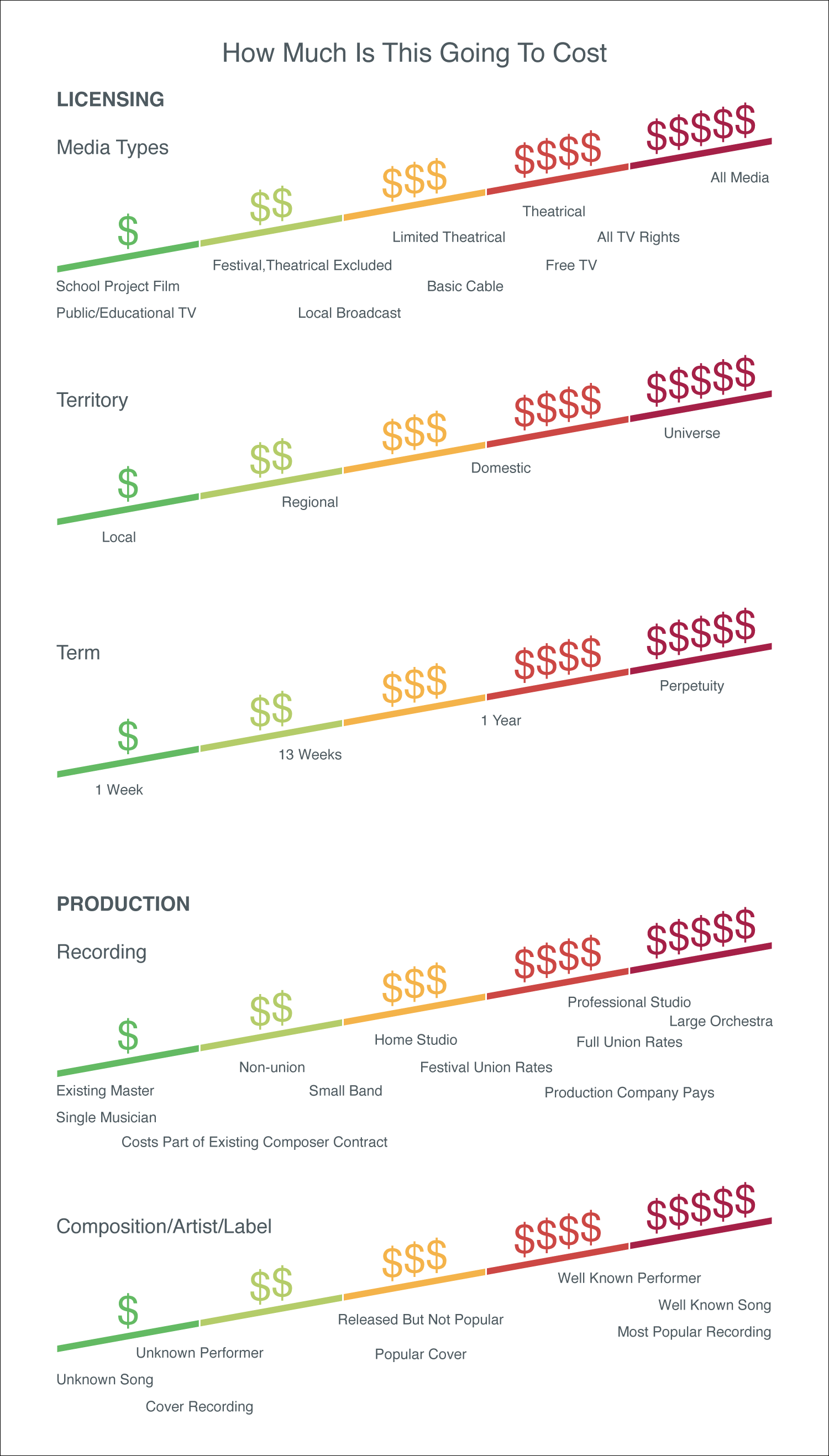
As a supervisor, you’ll need to know if a song and recording can not only be cleared, but can the production company actually afford it? At this point you’ll need to take in all the main ingredients of a license fee including media types, term of the license, and also the territories involved. Things can get a bit dodgy as you review the assets that you truly need, as some needs may be very low (limited term), and some needs may be high (all media now known or hereafter devised). In other words, depending upon your specific needs, the total fee may vary.
If your production budget is low, but you really want a particular song, then perhaps it’s time to look at producing or finding a cover version, or perhaps like in the case of Greta Gerwig, you reach out directly to a writer, or perhaps you already have a relationship with a writer/publisher/master owner that will immediately make the fee viable—just because they know you and will do you a favor!
In the table below, you’ll see a sliding scale of costs associated with a variety of needs, and of course extra variables that will come into play if you are finding or funding a cover version of the song.
Television Theme Songs
The role of the television theme song has changed quite a bit in the last 60 years. From a highly recognizable burst at the beginning of the show, to a less melodic soundscape that may be placed after a show’s recap, the uses of theme songs are as varied as the programming they are associated with. We’ll look at just a few of the thousands of television theme songs, and find some common denominators that make them work so well with the show that they are associated with.
Television Dramas
Television and film composer Mike Post seems to have the record for television show themes, with a dazzling amount of credits including NYPD Blue, L.A. Law, Law and Order, Hill Street Blues, Murder One, Silk Stalkings, and Rockford Files. He seems to be able to assimilate the very core of a show and deliver a theme that sums it all up. Aligning himself with television show producer Steven Bochco has proven to be a winning combination for both of them. Check out some of his most popular compositions.
Theme songs for shows will vary widely because of the tone of the show, the demographic that watches it, and the distribution medium. A show that is on a major broadcast network would not want to be taking up precious time that could be devoted to the episode, or commercial airtime, so the opening themes tend to be a bit shorter.
However, series on subscription-based platforms that do not rely on commercials can spend a fair amount of time on the opening sequence to get the viewer into the mood for the show without worrying about getting to the episode too quickly. Series that are released all at once and ready for binge-watching (no need to wait until next week) often include a button that says “skip intro,” allowing viewers to blow by the opening theme (and somebody’s hard work!) to get right into the episode.
Since we are talking about theme songs, let’s first take a look at a humorous take on the musical and lyrical elements that are often at play to help set the tone for some of the dramas of the first two decades of the 2000s. This clip is from the show Portlandia (originally airing on IFC, now available on Amazon and Netflix as well as other subscription networks), and they do a great job of breaking down the musical elements that you need for some of these types of cable dramas—with a bit of a wink.
Mad Men
Mad Men was a series that ran for seven seasons centered on advertising executives and set in the 1960s with all of the non-PC, excessive, and bad behaviors that went along with the competitive (and very lucrative) advertising environment. Right off the bat you would think they might go for something old-school and evocative of the times, but due to showrunner Matthew Weiner being stuck in some downtown traffic and hearing an instrumental snippet of DJ RJD2’s song “A Beautiful Mine” played between some NPR stories, that became the theme! The full song had a lot of parts that didn’t really work for the show, but with some intense editing, they arrived at a really unique flow that felt old school as well as contemporary (a bit disjunct, just like the storyline and characters!) and worked for the opening graphics.
The descending string line went so well with the visuals of the character falling; at the end, a last switch of the drum groove signals everything is okay; and then, at the very end, a very strident dominant 7th chord with a rather odd sound signaling that maybe all is not well after all.
Did You Know Beck Was Asked to Do the Music for Mad Men?
Of interest, Beck was originally asked to provide music for the opening to Mad Men, but turned down the offer numerous times, stating that he didn’t think there would be any interest in a show about 1960s ad execs! Also of interest, Matthew Weiner has stated in interviews that he was very hands-on with the music selections for the show, and often stockpiled music that he liked in a playlist, just waiting for the right scene to use it—reverse music supervision! Hats off and kudos definitely are in order for music supervisor Alex Patsavas, who I’m sure was a big part of the music selection as well. She helped determine whether a song being used was actually out and available at the time of the storyline—important details!
Dexter
The Dexter title sequence underwent many concepts and revisions, and with all things television, there were a lot of cooks in the kitchen! The initial edits for the visuals were actually cut to different music than we hear in the final version. The producers supplied the editor with the new score by Rolfe Kent, and the editor was initially taken aback and not as excited about the new music, as they had grown used to what they had been working with. As it turns out, the producers did indeed do the right thing musically. Eventually the visuals were edited to the music composed by Rolfe, and the magic happened—and the editor agreed it was the right musical choice. There is just enough whimsy and relaxed feel to the track that offset the rather exotic and sometimes darker qualities found in the theme. Also, note the length of the intro for a cable show in 2006!
For a very insightful exploration about the design of the Dexter opening sequence (and many others), check out this website and article (PDF).
Breaking Bad and Better Call Saul
Breaking Bad (AMC) and the prequel that aired after Breaking Bad was completed, Better Call Saul (AMC), both have unique stories for the theme songs.The Breaking Bad theme song was composed by series composer Dave Porter. Dave said that when he worked with series creator Vince Gilligan, even Vince wasn’t quite sure where the series was headed, but he did know the overarching story would be the de-evolution of the central character (Walter White), from being a straight-ahead guy to basically a gangster who would not let anything or anyone stop him in his pursuits. The challenge for Dave was to come up with a vibe that fit the overall feel of the show/locale, but also weave in some darker elements to foreshadow where things would eventually head. So, the first few seasons may have seemed like the theme was a little dark and heavy-handed, but as Walter descended into more of a gangster type, the theme fit him and the story well.
The Better Call Saul theme was arrived at a little differently and shows what influence a music supervisor can have when they have been actively listening and following unique artists. In this case Thomas Golubić had been following a band called Little Barrie, a UK garage rock band, and reached out to them to submit ideas for the short intro. They knocked out about 30 short ideas, and one of the early ones stuck. You’ll notice that the end is cut off abruptly, which is intentional. The character Saul was always working with small budgets, so it fit with the character that the intro would not be totally pro. You’ll see from the clip below that the intro theme got more and more cut up as each show went on.
The Last of Us
The theme for The Last of Us (HBO) is a masterclass in restraint and emotional storytelling through music. Composed by Gustavo Santaolalla—who also scored the original video game—the minimalist piece mirrors the post-apocalyptic world of the story, where a fungal outbreak has turned humans into zombie-like creatures called “the Infected.”
The theme relies heavily on sparse acoustic guitar, subtle rhythmic textures, and a haunting sense of space rather than a full orchestral arrangement. Santaolalla has explained that his goal was to use as little music as possible, incorporating organic sounds of objects you might find in a disaster, like pipes and cans. In this interview, he describes the style as “modern primitive folk music.”
Television Sitcoms
I Love Lucy
One of the all-time great theme songs from the 1950s is from I Love Lucy.
This catchy instrumental spoke volumes about the show, which featured Lucille Ball and her husband, nightclub entertainer Desi Arnaz. Desi had a band that was regularly featured on-camera in many of the episodes and the theme song closely mirrored the sound of the band in the show. The theme also captured the energy of the cast members and the zany scripts, a perfect marriage for the look and feel of the show.
The closing credits used the same theme music, but rather than veering off into all kinds of new material, composer Eliot Daniel kept the same theme and virtually repeated it three times! You won’t be able to get that melody out of your head, which is exactly the point!You can find some interesting facts about the composer Eliot Daniel on this page from the Classic Themes website.
Gilligan’s Island
Gilligan’s Island was a comedy that ran during the 1960s and has one of the most-remembered themes, written by Sherwood Schwartz and George Wyle, with lyrics that told the whole story about the castaways.
This version is from the second season; the original version was black and white. Notice how the theme utilizes some orchestral devices to help underscore the different characters as they are announced.
The first version stopped the character announcements when it came to the Professor and Maryann, instead referring to them as “and the rest.” Apparently Bob Denver (Gilligan) put his foot down and was able to get them billing.
This song is pretty campy, but once again, very memorable. An interesting arranging device is used by repeated key changes to keep giving the song a lift. On a historical note, John Williams wrote the score that was used in the show! From Gilligan’s Island to a houseful of Oscars!
All in the Family
All in the Family, starring Carroll O’Connor, Jean Stapleton, and an emerging Rob Reiner, ran through the 1970s. Each episode opened up with a unique theme song scenario, a featured on-screen performance!
The opening song, “Those Were the Days,” was written by Lee Adams and Charles Strouse. Strouse kept the piano part and melody as basic as possible to ensure that the on-screen performance was as intimate and believable as it could be. Strouse holds a degree from Eastman School of Music and had studied with some of the world’s best composition teachers, yet he knows when it’s time to stick to the basics. This Tony- and Emmy–winning composer also wrote music for Bye Bye Birdie and Annie.
Family Ties
Family Ties ran from 1982 to 1989 and among the show’s main stars was Emmy-award–winner Michael J. Fox. This show was a “family values” mouthpiece featuring Michael J. Fox’s Republican character. The show was rumored to be Republican President Ronald Reagan’s favorite television show!
The lyrics are interesting in that they talk about staying together for a million years, but the line about kissing (seems like a departure from the show’s basic theme) was dealt with on-screen with the adult couple kissing, and the embarrassed kids acting shocked. The rest of the lyrics seem to fit well with the show.
At that time, one of the composers, Tom Scott, was at the height of his career as a saxophonist and composer, and has continued to be successful in his work in film and concert music.
Check out Tom Scott Music to see more of his work.
This version of the theme song was brought in for season 2, featuring Deniece Williams and Johnny Mathis on vocals. The same song was used in the first season but without this star vocal power. Having stars sing the theme song can only help things! The production was classic 1980s with the chorused Fender Rhodes-style keyboard, and a heavy dose of reverb on the vocals.
Seinfeld
The 1990s sitcom Seinfeld was a radical departure from the usual sitcom scripts. It was largely Jerry Seinfeld’s comedic musings being acted out. His theme song, composed by Jonathan Wolff, was pretty much a non-song, but people will never forget the sound of that slap bass.
Check out this interview with Jonathan Wolff from the TAXI website.
The above article has great advice and insight from Wolff. He talks about the fact that a melody-based theme would have been in direct conflict with Jerry’s show-opening monologue, and the best fix was to write with sound design in mind. His goal was to capture the rhythmic pulse of Jerry’s delivery (apparently mm=110), and also stay out of the register of his voice.
Unbreakable Kimmy Schmidt
A unique opening theme as well as a gifted team of writers can be found on the show Unbreakable Kimmy Schmidt. A creation of Tina Fey, who has chosen a composer wisely—her super-talented husband Jeff Richmond. Jeff, Tina, and Robert Carlock share writing credits for this unique theme that defies the fast-forward control. Along with the unique song that really tells us about the character, they paired up with the folks that created “Auto-tune the News” for a unique production element to add to the opening. What results is extremely infectious. If you watch the show on Netflix, you’ll notice that the title does show a pop-up to skip the intro—too bad; it’s a good one! But if you don’t hit that button, you’ll also notice the steady build of instruments, an engaging set of vocals, and even a key change to move things forward.
In addition to the opening title, Jeff and the writers collaborate on many featured songs during the episode and really shine as a team.
Say It Quickly
In the early days, a network show’s opening may have been a minute in length, then it went to 30 seconds, and now several shows are clocking in under 30 seconds, and the trend is set!
With comedies, the writing and action is usually kept at a pretty quick pace. The exceptions are when shows have a bit more drama in the storyline. Since the show moves quickly, it makes sense to have the intro move quickly as well. Here are a couple shows that don’t make you wait around.
New Girl
New Girl started out with a generous 22 seconds, with vocals from star Zooey Deschanel (who co-wrote the song with Michael Andrews, Dave Finkel, Brett Baer, and series creator Elizabeth Meriwether). The theme was eventually downsized to about five seconds (without Deschanel’s vocals) over the show’s seven seasons.
Schitt’s Creek
Probably the reigning champion of short intro sequences has to be Schitt’s Creek, a CBC comedy that makes quick work of their theme—about four seconds!
In 2009 I scored a pilot for a show called The End of Steve, starring Matthew Perry. As part of the score, I had to write theme music for his local daytime talk program that takes place in the show. The theme needed to be convincing for a local-level broadcast. I did some research on current daytime talk shows, and used some of my own experience as a viewer to come up with a “generic,” feel-good theme. As a music supervisor, you may be asked to find some generic local broadcast talk show theme music, not for a show, but for a show within a show!
One conclusion we can draw after looking at so many different television themes is this: the theme must fit the overall vibe of the show and withstand hundreds, if not thousands, of repetitions. Even though we have moved away from the one-minute, full-blown song, we are still making an association between the song and the show. Whether it is an instrumental or a vocal feature, the song is going to set the stage for what follows. It should get the viewer involved and excited to stick around and see what happens next.
We have had an expansive view of opening themes and main titles used in a variety of formats, from network television to subscription television, and from radio to motion pictures. In all cases, themes have to survive repeated listenings, and in the best of circumstances, prevent you from pressing that “skip intro” button so you can soak up the vibe again and again.
As Thomas Golubić mentioned, it’s not just about the aesthetics, it’s also about the practicalities. How much time do you have for the intro? Five seconds, or a minute and a half? And of course, how much money can you spend on it? These questions will always need to be addressed before you start to find, or commission, the song that will be an instant recognizable sound of the show or movie the audience is jumping into!
STUDY MUSIC SUPERVISION WITH BRAD HATFIELD