



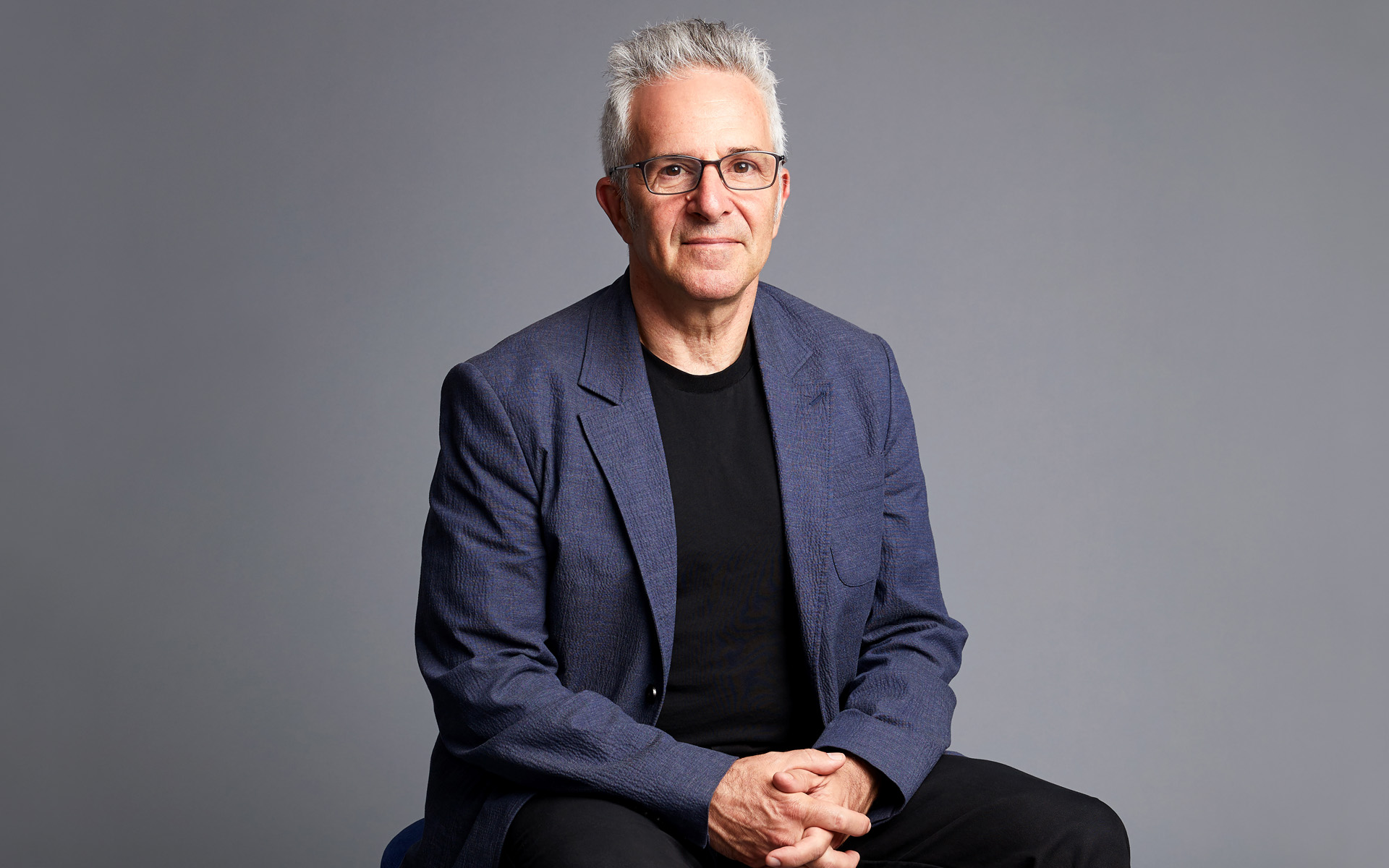
The Berklee Online Instructor Reflects on Nirvana’s Bleach, Frank Zappa and David Bowie Remasters, Mastering Engineering, Music Technology, and Teaching the Next Generation of Producers
For a mastering engineer who has worked with an incredible range of artists across nearly every genre, it makes sense that Jonathan Wyner’s musical awakening came when a substitute teacher plugged a trombone into a synthesizer. That combination of innovative experimentation and deep appreciation for musical tradition has continued to define Wyner’s career: He has performed with the Buffalo Philharmonic and mastered recordings by Nirvana. In between these extremes, he has worked with artists such as Frank Zappa, David Bowie, Josh Groban, Kiri Te Kanawa, and more.
Along the way, he’s never lost his affection for the French horn, a “devilishly difficult” instrument that he jokes is like being in a bad relationship. Today, he brings that same blend of humor, wonder, technical precision, and musical perspective to Berklee Online, where he teaches Advanced Audio/Music Mastering: Theory and Practice and Audio Mastering Techniques, which he co-wrote with Marc-Dieter Einstmann. In this Q&A, he reflects on the artists who shaped him, the technologies that transformed the recording industry, the innovations that will shape its future, and the curiosity that continues to guide him through it all.
What’s the first song you remember hearing?
Jonathan Wyner: Oh my goodness, the first song I remember hearing. I’m going to say it was one of two; either “Tubby the Tuba” from a Danny Kaye record of kids’ songs that had me howling when I was young. The other one was something called The Lieutenant Kijé Suite, written by Prokofiev. I was intrigued by the brass instruments and the trumpet when I was a young kid. It has some amazing trumpet writing. The shape of it and the melodies were kind of broadcasting the heroic aspect of the character. It was also set in a musical vocabulary that came from Russian culture and my family originally was of Ukrainian descent. So there was something very familiar to me about the harmonic vocabulary in the music.
You got your degree in the French horn. When did your relationship with that instrument begin?
Jonathan Wyner: I’ve gotta say, being a French horn player by definition means you’re involved in a bad relationship. [Laughs] Most people, if they go to the symphony orchestra, if you think about it for a moment, if there’s going to be a clam from the orchestra, just one clam, one mistake that’s made, it always comes from the French horn section. And that’s not because French horn players aren’t amazing. It’s because you never know what the instrument’s going to give you back. It’s devilishly difficult to play with accuracy and consistency. I think French horn, for me, was an opportunity that arose. I was playing other brass instruments and we needed a French horn in the orchestra. Nobody else wanted to play it, probably because they were smarter than me, so I said, “Sure, that seems like an interesting challenge.” And that’s really what set it off. The thing that really got my interest early on was how to extend the musical vocabulary and use instruments in unconventional ways. I think this came about because I was listening to a lot of pop music in the 1960s and growing up in a household that was filled with experimental classical music, so I mashed those two things up together. I was really intrigued by the non-conventional, so it didn’t take long for me to figure out what I could do with the French horn. That was something that nobody had ever heard before. I wasn’t especially interested in playing Mozart or Wagner for the rest of my life, but I started as a mid-teenager.
There was something in your Berklee bio about playing a horn into a synthesizer. Here’s the quote: “Driving CV triggers on an ARP 2600 from his French horn in 1977 set him on a lifelong journey to explore how technology can expand our creative vocabulary.” I think I’m going to need to know more about that.
Jonathan Wyner: That’s right! Actually, when I was a teenager in high school, one of the most important figures to me was a fellow, this substitute teacher, a real tall guy with a huge Afro, who walked in with his trombone and ARP 2600. He had drilled out the mouthpiece on his trombone and was running it through the filter sections on the ARP 2600. He just started playing for us. It blew my mind! It absolutely opened my mind up to what’s possible. Not just technically, but just goodness gracious, how can electronics augment what we do? That inspired me to undertake some of the same experiments myself. It took a few years before MIDI came along after that, but once MIDI was introduced, I got this thing called a Pitchrider, which was one of the earliest commercially available pitches-to-MIDI converters, and so I was driving MIDI synthesizers with various horns and playing duets with myself.
Do you remember that substitute teacher’s name?
Jonathan Wyner: I don’t! I feel so inadequate that I don’t. I can see him, though.
What year was that?
Jonathan Wyner: It was 1975, I believe.
Tell me about your education in music and how after connecting so much with the unconventional, you decided to pursue it in a conventional way. What was your thinking, pursuing a degree in music?
Jonathan Wyner: Originally for me, music was what I was going to do. It was the thing that I felt most affinity for. It was my native language. I started playing instruments before I spoke English, so there was kind of no question. I pursued it in school. It was part of my schooling in elementary school, junior high school, high school, and then it was most certainly going to be what I was going to do in college. That meant learning traditional Western and classical harmony, composition, writing, reading, as well as practicing in that context.
So my earliest education around music was sort of a traditional Western classical training. My introduction to audio as kind of an overlay on top of that goes to the story of the substitute music teacher who came into my class and kind of blew our minds by mashing up technology with what we were doing in the class. But also, going back before that, I remember listening to “Ball of Confusion” by the Temptations, which was a record that I think came out in the late 1960s or early ’70s. It’s got an introduction that uses a delay loop, but it’s not really a loop. It’s more like a slapback decay and a lot of reverb. It almost feels like sound design and sound effects.
I was like, “Oh my God, this is amazing!” So that was part of my musical vocabulary. While I was studying the classical side of things and traditional methods, it was clearly embedded in my brain that not only was [classical music] not all there was, but that was what was, not what was going to be.
So I was really hungry and eager to figure out where we were going, what the new technology was going to give us, and what new musical directions might be. This sort of notion of mash-ups between genres was something that was a relatively new idea, at least in the context of pop music in the 1960s and ’70s.
That’s really what set me on fire. That was my own personal experience with music education. Fast-forward a little bit, and I graduated with a degree in French Horn Performance and Music Composition. I had one foot in the door at New England Conservatory, spent a semester there playing the French horn, and realized that really wasn’t where I wanted to go. So I found my way to a small program called the Recording Workshop in Chillicothe, Ohio. There was nothing to do there but be in the studio, which meant it was perfect. After six weeks, it really set me on fire. It really validated that that’s what I wanted to do, so much so that the day that I graduated from that program, they asked me to stay and teach.
On the topic of education, one of the things that I’ve discovered is that the best way to test your knowledge, refine your knowledge, challenge yourself, and sort of look inside and investigate what you know and what you think you know, is to try to teach.
So I spent a couple of years doing that, and I think that was invaluable in terms of developing my craft. I stepped away from teaching for a couple of decades after that point, but a formal education has many roles in my life and my history.
When in your timeline did you start getting into mastering?
Jonathan Wyner: I finished the program in Ohio, and then, after a couple of years of teaching, I’d had some wonderful experiences meeting some musicians from there. Between Kool & The Gang, the Ohio Players, and James Brown, there was so much great funk that was coming out of that zone, and a lot of jazz, from Cincinnati and Columbus. I had started to develop some relationships with some musicians and started to produce some records, but I felt like it was time for me to move. So I found my way back to Boston at that time, and Boston was a wonderful place that hosted a diversity of music. I mean, name a genre and it was here; early classical music, traditional classical music. There was a jazz scene at Berklee and a jazz scene in the suburbs. Club Passim had the folk scene. There was a new wave thing that was happening here that was really rich. There was sort of the beginnings of [the band] Boston and the rock scene. It was rich and diverse, and that really suits me. So I started to develop relationships here. I started to work at a studio and started to produce. I was originally a recording engineer and a mixing engineer. Then one day, kind of out of the blue, there was an opportunity to go work in a mastering studio. It wasn’t something I was looking for.
So then what was the hook for you that really got you interested?
Jonathan Wyner: Well, there were a couple of things, but really, the thing at the time was that it was the first place that digital audio was really viable. The compact disc, born in 1983, had only been out for a year. It was a relatively new thing to try to figure out how to use the new technology and use it well. It was living on the bleeding edge. It was a little bit like a house of cards, dealing with digital audio systems. There was a lot to learn. It was exciting. It was terrifying. It was very expensive. It was an opportunity for me to learn about how to map the studio craft and the production craft to this new technology. Mastering is also awesome because it requires you to work across diverse genres. If you’re a fully employed mastering engineer, one day it’s a classical record, the next day it’s a rock record.
That kind of maps to what suits me, what keeps me interested. Lastly, this is maybe a less noble reason for having gotten involved in mastering, but immediately, everything that I was working on was of release quality! Before I started mastering, I might work on some demos with artists and I might work on some records that may or may not ever come out. I also might spend weeks or months working on a record, and it may not be my favorite record, but that’s what I was doing at the time.
Mastering was a new thing every day. It was going to be released, which meant that it had to live up to a certain qualitative standard, whatever you might say that is. By the way, in 1984 and 1985, that meant something very different! Today, anybody can create something on a laptop, hit publish, and it’s on the internet. But back then it meant investing time, money, and resources into planning a release, because it was going to be a physical object that you were making. So that’s all of the context for when I adopted mastering, or it adopted me.
When you say it was a new thing every day, were you in charge of that at that point? Would you say, “Oh, I have a pile of stuff in front of me. I’m going to pick this one.” Or would it be different assignments coming in from different labels?
Jonathan Wyner: As a music professional, you are for the most part at the mercy of the projects that present themselves. It’s rare that you’ll find somebody who can pick and choose everything they do on any given day, and that was certainly true as a mastering engineer. We would have a backlog of work that needed to be done and a schedule that we had to adhere to in order to make sure that we could hit the release dates, or the record labels could hit the release dates for the artists. To some extent, I had some latitude to decide what I was going to do on what day, but for the most part, that was kind of preordained by what was in the queue.
What was the first release that you worked on that you knew you’d done really well?
Jonathan Wyner: It’s a little bit challenging for me to remember what came first, but a couple of the earliest records that got me most excited were a Frank Zappa release. There’s a record called Roxy and Elsewhere, which was a favorite record of mine as a teenager. It’s got some amazing trombone solos by Bruce Fowler. It’s an amazing, amazing band. When that record came into the mastering studio, I was equal parts nervous and excited, and a lot of each! And this was made all the more so by the fact that Frank Zappa and Gail, his wife, were absolute control freaks. So, when the record came in, they wanted to make sure that everything that they put on the tape, was as it was recorded—and by the way, Zappa was an early adopter of digital technology, so he was sending us digital reels to master from, which was pretty unusual at the time—but we knew we had to make sure that we paid attention to every last tiny little bit of detail because he had the ears of a bat. He could hear the tiniest little flaw. The challenge was on to make sure that it went out in good shape and that we didn’t mess it up in any shape or form.
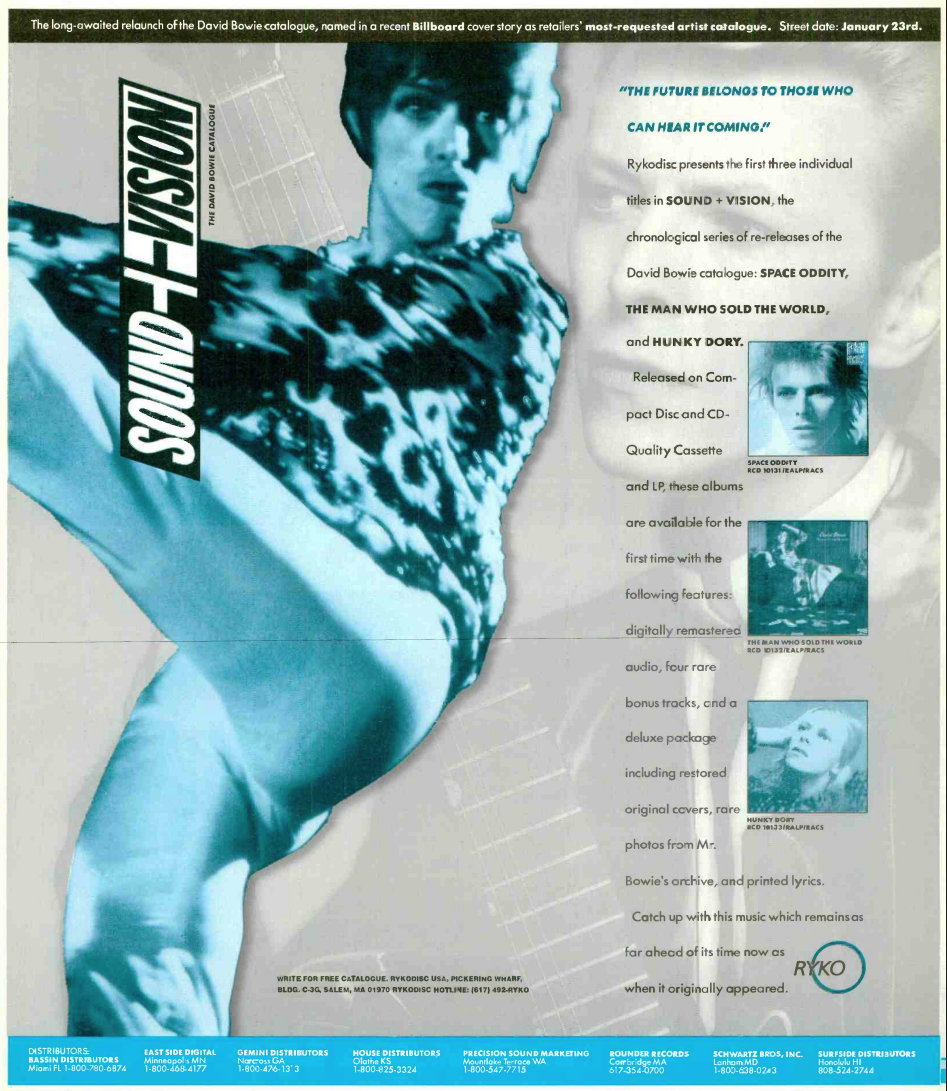
I remember an anecdote you shared about being nervous that you might damage the tapes with those Bowie releases. Can you please share that story again?
Jonathan Wyner: Oh, sure. A lot of the reels that came in from the Bowie archive were in pretty rough shape and some of them were just pancakes! If you’ve ever seen a reel of tape, most people have seen it with what’s called the flanges that hold the tape in place. Pancake means no flanges. So you’ve just got the raw tape spooled around something, and if that gets loose, then all hell can break loose if you’re not enormously careful in handling the tape! You also have to be careful—even with the oil on your fingers getting on the tape—because that can degrade it. I mean, tape is basically rust on plastic. So the oil from your fingers can be a little bit corrosive to the rust of the oxide side of the tape. So great care needs to be taken. You have to always be mindful of the heavy responsibility when you have an artist’s work in your hands. In this case, that responsibility felt amped up quite a bit.
In a blind listening test, could you identify the version you mastered or remastered among versions mastered by other engineers?
Jonathan Wyner: I think that if I were to listen to the RCA releases of the Bowie Records, and by the way, they initially rushed everything out. The contract between Bowie and RCA was ending, just before the contract between Bowie and Ryokodisc, who was my client, began. If I listen to the RCA recordings compared to the remasters that have been done since, I’m pretty sure I could hear the difference. It wouldn’t take me long. When you remaster something in a different period of time, I think the technology improves. You might think that when you’re remastering something, you’re trying to make it sound as good as you can for itself. Inevitably, there’s the influence of what’s going on in the wider culture. So the remasters that Ken Scott participated in about 20 years later sound pretty different from what we did.
Is there any degree of propriety amongst mastering engineers? I recall a funny piece from the satire site, The Hard Times, where the “guy who did original mastering” was pretty unhappy that the band had even wanted to remaster it.
Jonathan Wyner: When I go back and listen to the masters that we did, I probably would make some slightly different choices now. The technology has gotten so much better. We were converting everything from the analog tapes and the converters at the time weren’t that great. The kind of differences I’m talking about are relatively small. It’s not like the songs have changed, but the new converters nowadays would recognize the difference in the warmth and the sense of depth in the recordings. Boy, I wish we had that technology back then! But do I think that we did as well as we could, given what we had at the time? Am I really happy with the results? Yes! Do I agree with everything that’s happened since then? Maybe not, but also I don’t ever feel what I would call hubris to say that I always have the right answer. When I’m mastering something, I have my take on it. I’m trying to interpret what an artist is doing and serve the art as well as I possibly can. Somebody else is going to do their version of it.
How competitive is the field? Any anecdotes you can share about that?
Jonathan Wyner: I had the occasion to do a number of mastering projects for a band called Aerosmith, and some of which were complete albums, some of which were some archival work. But there was one case in particular where I was working on a single that was going to be included in a movie. I mastered it and I came to find out after the fact that—and this is what I was told, of course, you never really know—but they had also sent it out to a couple of other mastering engineers and that the band had chosen my master, but they didn’t end up using it because they wanted the mastering engineer who had a bigger name than mine! That was an interesting lesson, and it made me understand some things about the industry and also understand what was important to me about the work. Did I really want to believe that what they told me was true? You bet I did! But that was a case where I got some feedback that I wasn’t really expecting. Nobody had told me upfront that they were going to be doing a shoot out, but there you have it.
Give me any anecdotes you have about an artist giving you positive feedback or do it again.
Jonathan Wyner: There have been a number of moments over the course of my career. It’s not a straight line. It’s not like everything goes well. It’s not like everything’s positive. But I think one has to have an attitude that there is always something to be learned from every encounter, positive or otherwise.
The things that are challenging, ultimately, looking back, I truly believe I gained things from—learnings or experiences—that I would not have otherwise.
I think I’m struggling to come up with a great story about feedback. I had a long relationship with a producer named Mike Denneen. Mike actually had been a faculty member here at Berklee, and was the owner of Q Division Studios here in the Boston area, where lots of really great records have been made since the late 1980s.
Having a longstanding relationship with somebody who trusts you, and who can be honest with you, is invaluable. It’s the best kind of friendship and the best kind of professional relationship. I remember the day that Mike came to me and asked me to master a record by an artist named Jen Trynin, a local artist who ultimately got signed to Warner Brothers. This was her first record for an indie label, and I knew that this was important to Mike because, ultimately, Jen became his wife. So I think this may have been his audition for him, for bigger things in life! Anyway, when he gave me the record to work on, and when I handed it back to him, he was just over the moon, talking about how he was hearing things in the music that he didn’t even realize were there anymore. It was so satisfying and so gratifying. When an artist says, “I’m hearing myself” or a producer says, “I’m hearing the music in the way that I had hoped I could hear.” Or “I never realized I could experience it in this way,” that’s just the best feeling in the world.
I mean, we’re ultimately providing a service back to the artistic world, so it’s validating and satisfying.
I remember another anecdote you shared with me one time about digging through some tapes to work on, and there was a tape called Bleach, by a band called Nirvana. I think we need to get that story on the record, as it were!
Jonathan Wyner: This is why I’m not in A&R. In the late 1980s, it’s probably 1988 or 1989. I was doing a bunch of work for a small record label. It was just getting started in the Seattle area called Sub Pop. They were producing some interesting—I think “grunge” was not really a thing yet, but it was kind of the beginning of what would become grunge—cool, vibey, raw records, for bands from that area. I remember on one particular day getting a box of reels, I’m pretty sure it was mid-July. I remember it was kind of warm in the studio, and I actually can remember the place and even almost the smell of the tapes coming out of the box. These were all quarter-inch reels. I had a couple of days to work on these records, and the first one I pulled out was by an artist named Mark Lanegan, and the record was called The Winding Sheet. Really interesting, almost kind of prog-folk, is how I would describe it. Then there was another record by the Screaming Trees, their first record, which was awesome! Great energy, great writing. Then there was another record by a band called Nirvana who I’d never heard of before and the name of the record was Bleach. It was a cool record, but it didn’t grab me the way the other ones did. All the records together kind of set a sense of place and genre from that area, but that wasn’t the one that really grabbed me. So back to the punchline. I never really saw that Nirvana was going to become Nirvana, and maybe they weren’t at that time. But I do look back and think, “Wow, I just missed that!”
When did you have that moment with Nirvana where you heard them again and thought, “wait a second”?
Jonathan Wyner: I do remember hearing Nevermind and thinking, “Oh? Yeah, I didn’t see this coming, but these are the same people. Somewhere in there was the DNA.” And, you know, “Kudos to the production team that made that happen!”
Tell me a little bit about the work you’ve been doing with AI and BEATL, coming along with the work you’ve done with iZotope and AI mastering. What is the wisdom you deliver to students when talking about AI?
Jonathan Wyner: I feel that one of the things that I can bring to discussions about music technology is the perspective that comes from having seen different technologies be introduced and understand ways that they’ve impacted esthetics, workflows, and the economy around music-making, and music distribution. If you look back at MIDI or at music streaming, the onset of MP3s, and file-sharing, there are lots of different interesting takeaways, stories to tell, and insights that can be gathered by looking back at what has happened.
So looking back to look ahead, thinking about AI, it is in some qualitative ways, a different phenomenon from anything that we’ve encountered before, particularly from the perspective of generative AI. But it’s not all that different in the sense that it’s a new technology, it’s here, and I think it’s really important that everybody learns what it is and how it becomes useful in different contexts.
It has very different utility in the context of songwriting, compared to mastering, compared to music distribution. There’s AI all over playlist curation and delivering preferences out to listeners, so it shows up in lots of different ways. It’s important that we learn about it, learn about what it’s good at, learn about what it’s good for, and learn about ways in which it’s actually not yet up to par. The quality of the signal that comes out of generative AI is not good enough today to be featured in a high-level music production. There are generative components that might show up in a mix or in a production, but as a wholly fully formed thing, generative AI still doesn’t sound that good, or good enough. That’s not to say that it won’t! I think it’s important that we pay attention, learn about it, and stay informed. There’s all of the conversations about the ethics around it. People use this word, “ethics,” I think, to talk about the morality around it, but also about the economy and the implications around AI.
I think it’s important to have robust discussions about that—which I do all the time with my students—to parse those topics, like “How do you feel about it?” and “How might IP change?” and “What will it look like to you in your career, going forward?” as well as “How might you be able to use it as a collaborative tool with people?”
So I think breaking it down and having more nuanced discussions about this new technology is not only critical, it would be irresponsible of us to not do that.
After such an illustrious career, which is still going, what brought you back to teaching?
Jonathan Wyner: I think teaching has always been a natural extension of what I do. Whether I’m teaching other people or whether I’m teaching clients. When you’re collaborating with people around a part of music production that they may not be that familiar with, there is some education that is required. I also found myself starting to make YouTube videos, partly as a promotional sort of component of what I did at my studio in the 1990s that started to become a thing that one needed to do. An aspect of that is giving back to people.
There’s another aspect of it, which is, for me, personally, the myth-busting. I think there’s a lot of misinformation that accrues. So if there’s some way that we can have a fact-based information share, rather than leaning totally into the vibey vernacular that sometimes develops around music production, I think that’s incredibly important to help people realize their goals and get better at what they’re doing.
So all of that was sort of in me, and was a component of the work that I did. I started to work with a company called iZotope, and to their credit, they were an innovative, inventive bunch of computer science students coming out of MIT, who also had some affinity for music but knew nothing about music production and they knew that they didn’t. When I started working with them, they were eager for me to bring my expertise and help educate their customers and developers, and product designers. That is really kind of what kicked off my return to education in a more dedicated way.
Several years after that, I was asked to author a course for Berklee Online. I was called by the brick-and-mortar school here to come back and teach a couple of sections of a mastering course. It’s been kind of the most organic, longest sort of audition for a full professorship at Berklee College of Music. Teaching is something that has grown out of my interest. The experience that I’ve had qualifies me to talk to people about the ins and outs of the topic that I teach around.
How would you describe your teaching philosophy?
Jonathan Wyner: My teaching philosophy is, first of all, to meet the students where they are, to understand where their brains are. Ultimately, what we are doing is trying to train our brains and integrate information, upgrading our knowledge so that we can bring that to bear on something creative. I think the word “integration” is ultimately what’s most important to me.
It’s not about just delivering facts. It’s not about memorizing things, but it’s about understanding the implications of everything that we do as it serves art, and as it serves music. My method is to create a lab, a place where students can engage in experiments, observe what happened, and then figure out what went well and what didn’t go well. Then rinse and repeat, and gradually scaffold and upgrade on top of those experiments. I try to break things down to a very basic, digestible idea instead of trying to boil the ocean all at once. We go a cupful at a time. But for me, it’s all about trying to upgrade a student’s perception by introducing an idea, having them experiment with the idea, encouraging them and helping them unpack what happened, and then going back and doing it again.
Do you have any students that you’re especially proud of?
Jonathan Wyner: I’m enormously proud of, humbled, and pleased in the same way that I have some children of my own. [Laughs] I take great pride in seeing them succeed in the world. I’ve had both interns and students who have gone on to do very well. Adam Ayan was an intern of mine who became Bob Ludwig’s protege and now is doing incredibly well with more Grammys than, well, you need a bigger room than this to hold his Grammys! There’s Jett Galindo, who graduated, I believe in 2012, and she became a protege for Doug Sax, and is now off doing her own thing, doing incredibly well in LA, and she has Grammys. Oscar Zambrano, who graduated I think maybe a few years before, is in New York and he was both an intern and a student of mine. There’s also Josh Sebek. He’s cutting a bunch of records at the 1979, and he graduated just a few years ago from the Boston campus. Just amazing people. There are others who are doing well. Any time that we have a student succeed, it’s validating, but mostly it makes us feel so good to see that people are getting to do what they want to do.