Sean Slade helped shape the sound of ’90s alt-rock, from Boston’s Fort Apache studio to Radiohead’s breakout hit “Creep.” In this Q&A, he shares the stories, instincts, and creative risks behind those sessions, along with the lessons that continue to guide his work as a producer and educator, teaching in Berklee Online’s Music Production grad program.
As a musician, not all of your practice will be on your instrument. Some of it will be in your head, and some of it may even be on objects that just look like your instrument. We call this mental practice, and in this excerpt from Barbara LaFitte’s Practicing Techniques for Musicians course, the former principal oboist in the Boston Ballet Orchestra shares tips on how to practice your instrument when you just aren’t able to actually play your instrument.
Wondering where to take your music career? Explore the best cities for your professional life through expert advice from Berklee Online instructors and alums who currently live and work in Nashville, Los Angeles, New York City, and Miami.
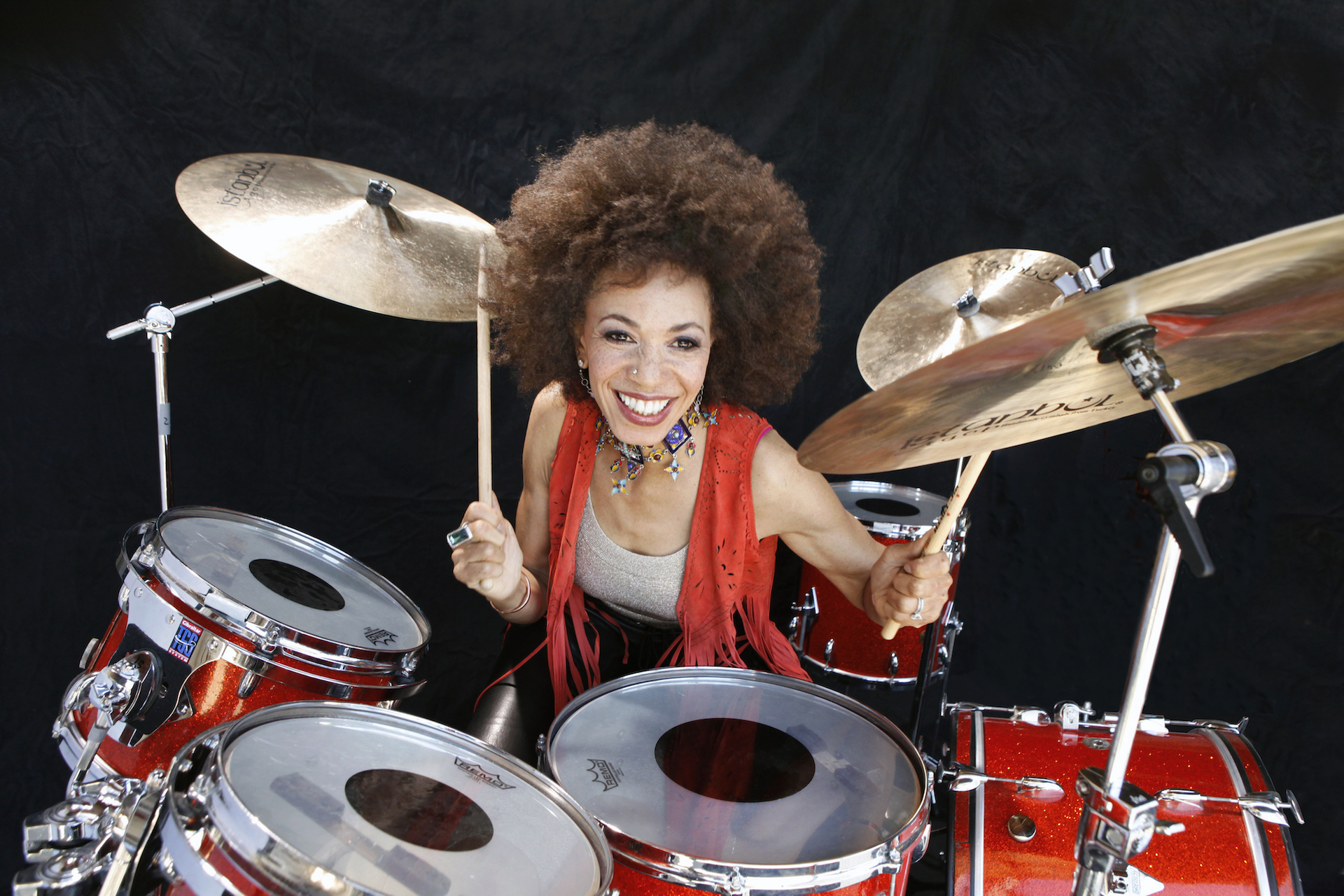
Cindy Blackman became Lenny Kravitz’s drummer after a lifetime of jazz drumming. In this wide-ranging interview she discusses being visited by the spirits of the jazz greats she befriended during her time in New York City, and how she and husband Carlos Santana stay in harmony, onstage and off.
Explore Six Decades of Stereo Panning, from Psychedelic Guitars to Modern Pop
Stereo panning can completely transform a mix, adding depth, movement, novelty, and sometimes even surprise, especially when you’re wearing headphones! We asked Berklee Online’s Music Production instructors to share their favorite examples of moments in recorded music where the placement of a sound becomes part of the experience itself. Some of their choices highlight the subtle art of stereo imaging; others use panning in ways that practically demand the listener’s attention.
For me, one of those moments is “Blitzkrieg Bop.” The Ramones pan the guitars hard right, the drums and bass mostly left, and double Joey’s voice in each ear. It’s raw, it’s lopsided, and it’s perfect. You can hear the personality in each band member’s part, but also how perfectly they work together as a unit worthy of sharing the same surname.
But enough about me. Let’s see what the Berklee Online instructors have to say!
Check out the playlist above or follow along track by track to hear how producers have spent six decades messing around with the space between your ears. Pop in your AirPods (or strap on your giant ear cans) and prepare to hear some familiar songs in entirely new ways. Take it away, Berklee Online instructors!
An example of great panning that’s worth mentioning is “Maiden Voyage” by Herbie Hancock. Freddie Hubbard’s trumpet and George Coleman’s sax each get their own position, left and right, respectively, as if they’re deep in conversation!
Jimi Hendrix Experience, ‘EXP’ and ‘Bold As Love’ (1967)
As a child, I was fascinated by stereo records, and would lie on the floor with each of the speakers from our home stereo on the side of either ear. Stereo was originally used to make recorded music sound “real.” We had two ears, why not two speakers? I remember first listening to Axis: Bold as Love by the Jimi Hendrix Experience this way. From the opening track, “EXP” with feedback guitars panning right to left, it became abundantly clear that this was a new kind of recorded reality. Throughout the record, guitars move between the stereo channels; gone was the idea that we were listening to a band just playing. On the closing track, “Bold as Love,” all of this comes to a stunning climax when at 2:48, we hear a swirling audio effect on the drum fill that leads into the closing guitar solo with stereo flanging.
The Jimi Hendrix Experience, ‘All Along the Watchtower’ (1968)
One of my favorite panning compositions is the centered lead vocal in “Take a Stroll Thru Your Mind” by the Temptations. The lead vocal begins in the center of the stereo field and begins to drift to the left at 0:14, while simultaneously introducing a slapback delay (a bit more than a sixteenth note at about 180 ms) that drifts to the right. The second vocalist comes in at 0:47 using the same effect. At 1:51, the third vocalist comes in with no reverb, no slapback, and appears solidly in the center of the song. This was my introduction to an extreme use of the stereo field, and I never forgot it, so much so that I used a variation of it on Debo Ray’s composition “You Read Me Wrong,” released in February of 2025 on her self-titled album.
Hard panning of doubled guitars is an effective technique that has been put to excellent use for decades: instead of playing a rhythm guitar part once, play it twice on two different tracks, then pan them hard left and right. The two tracks played back together provide a magical effect, and the hard panning opens up the center of the mix for the lead vocal.
Right from the top, both the electric and acoustic guitars are doubled and panned hard left and right; the chorus effect created by the electric guitar provides the simple yet memorable instrumental hook of the song, instantly recognizable. The punchy acoustic guitars continue throughout the track, and allow Glenn Frey’s lead vocals to sit perfectly in the mix without being pushed too far forward. Interesting note: the acoustic guitars, while both hitting the main accents, are not perfectly identical performances, which actually adds a bit of depth to the stereo field.
Another example of this technique, this time with Joe Walsh’s iconic electric guitar riff. The record begins with the hard-panning technique on two performances of the same part. This time, the performances are nearly identical. After the first statement of the riff, two more guitars join in an octave higher, also panned hard left and right. This hit single is an excellent masterclass for panning guitars, as there are so many guitars, many of them double-tracked, and yet the mix never gets cluttered, and there’s plenty of space for Don Henley’s lead vocals.
A great present-day iteration of this same technique. Once again, the record begins with the punchy acoustic rhythm guitars, double-tracked and hard-panned left and right. This continues throughout the arrangement, the click of the pick on the guitar strings providing effective subdivisions that push the rhythm of the track forward. An interesting additional note is that the group vocals on this single are also panned hard left and right, leaving lots of space in the center for Ed’s lead vocal, which is essentially the only thing occupying that frequency range in the center.
Tracy’s acoustic guitar intro shows that this technique works as well for fingerpicking as it does with a flat pick. The sparse production of this record also demonstrates how doubling and hard-panning the acoustic guitar helps to fill up the space with minimal instrumentation, focusing us on the lyrics of the song.
This time with a 12-string guitar, right from the top of the intro, the hard-panned dual guitar performances set the stage of the mix while leaving copious amounts of space in the center for Tom’s understated vocals on the verse (and gripping, higher-register vocals on the chorus). Later in the song (3:20), the electric rhythm guitars, also doubled and hard-panned, take over the space originally occupied by the acoustic 12-string.
Guided by the aforementioned greats, I’m throwing my own panning adventure into the mix. On this track, which I recorded with Annette (a.k.a. Zahara) during the pandemic in a 100-year-old former Hell’s Kitchen piano factory with noisy steam heat, the ukulele makes up the entirety of the instrumental track. The double-tracking and panning pull double-duty, simultaneously filling out the stereo soundstage while giving the entire center of the recording to the vocals.
From mono to fully immersive, record production has always been about creating a scene that captivates and transports the listener through sound alone. To be effective, this often requires a degree of hyper-realism or exaggeration. Steely Dan’s “Babylon Sisters” represents an iconic pinnacle of this art form in the world of stereo production. Every source is locatable with remarkable clarity and precision, creating a soundscape of unparalleled depth and width. From the doubled, hard-panned trumpets to the ultra-wide background vocals, and from the bell tree to the tom fills, every detail can be heard, identified, and precisely placed within a soundstage that envelops the listener musically and sonically.
While the effects used in the Hendrix recordings I selected earlier were made in the studio, I became fascinated with stereo as a compositional tool after listening to the King Crimson album, Discipline. On the title track, we hear Robert Fripp and Adrian Belew playing interlocking single-line parts panned opposite each other, going in and out of polyrhythms clearly influenced by Gamelan music. These can sound like a single part with casual listening, but listening in headphones, the hypnotic effect of the guitars panned opposite of each other is otherworldly.
A balanced and wide stereo image is a staple of modern productions. Thanks to the virtual instruments that sound larger than life, stereo recording techniques, double-tracking techniques, and effective panning strategies. To me, nothing beats double-tracked and hard-panned tight rhythm guitars. Double tracking creates a wider stereo image and helps guitars get out of the way of the focal point, which is usually the vocal panned to the center. Although the focal point is not the vocal but the lead guitar, check out Joe Satriani’s classic “Surfing with the Alien” for a great example of this. The crunching rhythm guitars lay the foundation of the track. Also, hats off to John Cuniberti, who tastefully engineered the record, which had a super tight budget. Honorable mention: The swooshing sound effect with panning automation can be heard several times throughout the track; at 1:10 and between 2:34 and 2:40.
Here are two bold takes on drum panning:
“Measure” by Field Music<
and
“It’s Nearly Africa” by XTC.
Panned elements steal focus if they are prominent in the mix, and snare drums are typically up the center to drive and support a song. In these two examples, the drums take greater focus, akin to how a rhythm guitar or keyboard might ordinarily occupy a supportive yet prominent place in a mix.
Manowar, ‘The Warriors Prayer’ and ‘Blood of Kings’ (1989)
I was so impressed when I first heard the sound effects of horses with panning automation on “The Warriors Prayer,” a spoken word track from Manowar’s Kings of Metal album. I know it’s cheesy, but I was probably in high school, listening to that track on headphones through my Walkman, lying in bed at night in the dark. I felt like the horses were running through my brain! A memory that I keep remembering all these years later. And yes, the headphones probably had orange colored ear cushions.
Another cool stereo panning trick is Timbaland’s production of “Pony” by Ginuwine (1996). The song is very popular, and most people don’t realize there are three snares, one centered, one left, and one right. The one on the left is pitched higher than the center, and the one on the right is pitched lower than the center. You can actually hear the one on the right play a few beats independently from time to time, and the one in the center is revealed a few times. What an awesome stereo field Easter egg for producers and mixers to find.
The song “Baby Doll” by N*E*R*D is relentless in its use of panning. It feels as if Pharell Williams and Chad Hugo listened to all the old white men mix engineers with their rock music “rules” about panning, and said “fuck that, we are going to break all those rules!” And they do so, repeatedly and consistently throughout the song. In analyzing mixes, before I heard this track, I thought of panning as a way to help the listener focus on specific elements, or create a realistic space. This track was the first time I considered using panning for shock value. The track starts with drums that are basically mono, in the middle of the mix, and subtle breathing whispers only in the left ear, quite intimate and unusual to begin with, and connects to the meaning of whispering in a baby doll’s ear. After that the listener begins to accept that the panning feels pretty typical, but just wait! At 1:40, the drums shift all the way to the left channel and the vocals to the right ear! It was so strange that when I first heard it I almost fell off my bicycle! As soon as I got back on my bike (and re-seated my earbuds) I got to the 2:33 mark, where the entire drum kit pans (during a drum fill!) to the right side, and the vocals to the right also, with a strong guitar in the left. This shift had me nearly turning my bicycle into pedestrian traffic. That’s when I decided it would be best to pause and listen to the rest of the track while standing still. From that moment on, I had a new way to approach panning: for shock and awe!
Another interesting one is Beyonce’s “Lo-o-ove” on “Drunk in Love” (2013). There are four of them starting at 2:34. The first three are centered with a bit of reverb. And then the fourth one auto-pans from the left to the right with extreme flanging on it. It’s another awesome Easter egg that I’m sure I used in a mix after I heard it. A big shoutout to my mix engineering colleague, Tony Maserati, for creating that effect.
I selected a few of my productions where I get giddy with panning. For us music makers, there is a particular kind of joy in understanding the different technical buttons we push in order to create an emotional reaction. But I always try to remember that all of this technique and know-how ultimately serves that bigger objective: an emotional goal!
Panning is an underrated and excellent example. It is often treated as a purely technical tool—something we use to alleviate masking in a mix, create a wide stereo image, or approximate the way we experience sound in the real world. But I find the emotional potential and power of panning to be way more interesting—and so much fun!
One example that comes to mind is the production and arrangement I made for my fellow compatriots, Los Amigos Invisibles, on our Grammy-nominated song “Ten Cuidao.” In my mix, I tried to convey a playful, spatial game of peekaboo, delineating the verse, prechorus, and chorus with very contrasting spatial presentations that counter each other. If that sounds a little bit convoluted, I invite you to get your favorite hi-fi headphones and give it a spin. Pay special attention to how the percussion and guitars are always engaged in a left/right tug-of-war throughout the song. Also, note the panned güiro solo at 2:07!
Another favorite of mine is my production of the song “Mini Uzi” by my childhood heroes, Desorden Público—they were my favorite band when I was nine years old! Right before I graduated from Berklee, I met these cult ska legends and got to produce a song for them; we clicked and bonded through our shared love of creatively breaking genre conventions and bending expectations.
This particular song deals with intense reflections on growing up in a violent, hostile urban setting; love, survival of the self, and defending your family through it all. I tried to convey the tension behind the exposition in the verses by purposely creating lopsided, jarring panning decisions, then contrasting them with the emotional release of a symmetrical stereo chorus.
Put your headphones on and give it a spin. Pay special attention to the development of the second verse and outro, particularly the spatial placement of the machine-gun samples!
These two examples illustrate what I find most exciting about production: the moment when a technical decision ceases to be merely a technical choice and becomes part of our storytelling. Tools are important, but what I value most is how we use them to convey meaning, evoke emotion, and ultimately shape what we feel.
And finally, we were all warned about using stereo imaging on low-frequency content. So, explain the stereo bass on “Unholy” by Sam Smith (feat. Kim Petras)! I love this song and the stereo perspective of the bass line.
One of my favorite examples of stereo use in a mix to light up the song is in Ryan Beatty’s track, “Ribbons.” I’ll keep my notes intentionally vague to not spoil it if this is your first listen to the song!
The lead vocals enter in the center, with a second lead entering and both panned slightly left/right at 0:29. It gives the song a perfect life for both the melody and lyric at that time. Even more striking, the vocal then collapses to mono at 0:57, again hammering home the emotion of that moment of the story. When it opens back to stereo at 1:24, it’s just the beginning of a truly stunning second half of the song.